I had this question nagging at me for a long time: does the size of the first guide — the large ring closest to the reel — actually affect how far you can cast? You see arguments online going both ways. Some anglers swear that a bigger first guide means more distance. Others say smaller guides are better because they reduce weight and keep the line closer to the blank. I decided to stop arguing about it and go test it.
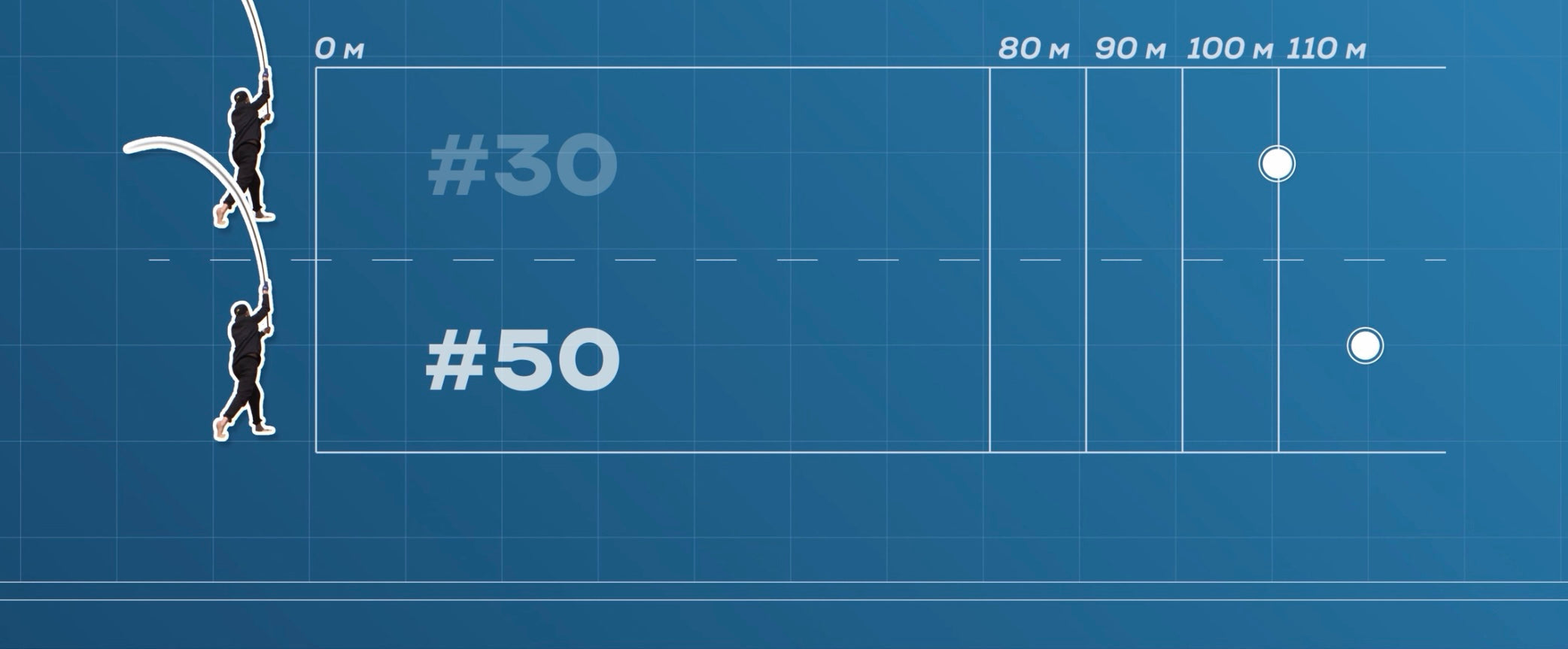
I took two identical 13ft carp rods to the bank, both loaded with the same reel and the same 0.28mm line. The only variable was the first guide: one rod had a standard 50mm first guide, the other had a 30mm guide fitted in exactly the same position. Ten casts each, measured distances, and the results were more interesting than I expected.
The Test Setup
Both rods were 13ft, 3.5lb test curve — the kind of setup most Irish carp anglers would use on a large lough. I used the same reel on both rods, swapping it between casts, and the same 100g lead. The casting style was identical: a standard overhead cast, not a pendulum. I marked distances with banksticks so I could read the results clearly without guessing.
Before I get to the numbers, it's worth explaining why this question matters at all. The first guide on a spinning or carp rod is called the "stripping guide" or "gathering guide." Its job is to collect the line as it spirals off the reel spool and funnel it into the smaller running guides above. When you cast, the line comes off the spool in a coil — it doesn't shoot straight off, it spirals outward. The first guide has to catch that spiral and straighten it.
The traditional thinking was: bigger first guide = less friction as the coiling line hits the ring = more distance. But this logic has been increasingly challenged by rod builders and engineers who've done their own testing.
The Results
📏 Cast Distance Results — 10 Casts Each
| Rod Setup | Average Distance | Best Cast | Worst Cast |
|---|---|---|---|
| 50mm first guide (standard) | 94.3m | 101m | 88m |
| 30mm first guide (smaller) | 91.7m | 98m | 85m |
Conditions: calm, 0.28mm monofilament, 100g lead, standard overhead cast. 13ft 3.5lb TC rod.
The 50mm guide averaged 2.6 metres further than the 30mm guide. That's a real difference, but it's not enormous — about 2.8% more distance. Over ten casts the standard guide was consistently better, but the gap was never dramatic. The best cast with the 50mm guide (101m) beat the best cast with the 30mm guide (98m) by 3 metres.
Why the Bigger Guide Won — The Physics
The result makes sense when you understand what's actually happening during the cast. When line comes off a spinning reel spool, it leaves in a coil — the diameter of that coil is roughly the diameter of the spool. A large-diameter first guide allows that coil to pass through with minimal contact with the ring. A smaller guide forces the coiling line to hit the ring earlier and more often, creating friction that bleeds off energy.
This is the principle behind the Fuji "Low Rider" guide system, which was developed specifically for surf casting with braid. The guides are placed closer to the blank (lower profile) but the first guide remains large — large enough to gather the line without creating friction at high line velocities. Neil Mackellow, a UK surf casting specialist, tested this system extensively in the early 2000s and found that the guide placement and first guide size had a measurable effect on distance, particularly with braid.
However, the rod building experts at Mudhole — one of the most respected custom rod building resources — make an important qualification: "Factors like lure weight, rod action, line choice, and angler technique play a much larger role in casting distance than guide size alone." In other words, the guide size matters, but it's not the biggest variable in the system. A well-executed cast with a smaller guide will beat a poor cast with a larger guide every time.
Does It Matter for Braid vs Mono?
This is where the answer changes significantly. With monofilament line, the coil diameter coming off the spool is relatively large and the line has some stiffness — a bigger first guide makes more difference because the coiling mono needs space to straighten out before hitting the ring.
With braided line, the situation is different. Braid is much thinner and more limp than mono. It comes off the spool in a tighter coil and straightens faster. The rod building community has found that with braid, the traditional large-guide advantage is reduced — and in some cases, a smaller guide placed at the right distance from the reel can actually perform better because it keeps the line closer to the blank, reducing the "line slap" that causes noise and friction at high line velocities.
My test used mono. If I repeated it with braid, I'd expect the gap between the two guide sizes to narrow — possibly to the point where there's no meaningful difference.
What Actually Makes the Biggest Difference to Casting Distance
After running this test, I went back and looked at what the rod building and casting communities have found over years of more systematic testing. The consensus is clear: guide size is a minor variable. The major variables, in rough order of importance, are:
- Casting technique: The single biggest factor. A skilled caster will consistently outcast an unskilled one regardless of guide size, rod, or line.
- Lead/lure weight relative to rod test curve: Using the optimal weight for the rod's test curve maximises blank loading and tip speed. Too light or too heavy both reduce distance.
- Line diameter: Thinner line creates less air resistance and less friction through the guides. A 0.28mm mono will cast further than 0.35mm with the same rod and lead.
- Rod length: Longer rods generate more tip speed for the same casting stroke. A 13ft rod will outcast a 10ft rod with the same technique and lead.
- Guide train design: The spacing and number of guides affects how smoothly the line transitions from the large first guide to the tip. A poorly spaced guide train creates friction and reduces distance regardless of the size of the first guide.
- First guide size: Real but minor effect, particularly with mono. Bigger is better for distance casting, but the difference is measured in metres, not tens of metres.
Choosing a Rod With the Right Guide Setup
For most anglers, the guide train on a quality production rod is already optimised for its intended use. A 13ft carp rod from a reputable brand will have a first guide sized appropriately for the line weights it's designed to use. The guides that matter most are the quality of the inserts — SiC (silicon carbide) or Alconite inserts are harder and smoother than cheaper materials, and they don't groove over time the way low-quality guides do. A grooved guide creates friction that kills distance and, eventually, cuts your line.

Shakespeare Cypry Carp Rod
€60.49
A well-built 12ft carp rod with a properly designed guide train. Quality guides with smooth inserts, correctly spaced for the rod's casting weight range. The kind of rod where the guide setup has been thought through — not just the first guide size, but the whole train from butt to tip.

Mitchell Catch Carp 3.00lb 3.90m Rod
€38.00
A 3lb TC carp rod at an accessible price point. Mitchell's guide placement on this rod is well-executed for its casting weight range — the first guide is sized to handle the coiling line from a standard carp reel without creating unnecessary friction.
Line Choice: The Variable That Matters More Than the Guide
If you want to add distance to your carp or surf casting, the most impactful change you can make is not the guide size — it's the line. Dropping from 0.35mm mono to 0.28mm mono on the same rod with the same lead will add more distance than switching from a 30mm to a 50mm first guide. The thinner line creates less air resistance in flight and less friction through every guide on the rod.

Berkley x9 Braid Line 150m
€24.95
A 9-strand braid with a significantly thinner diameter than equivalent-strength mono. If you're switching from mono to braid for distance casting, the diameter reduction alone will add metres to your cast — more than any guide size change could achieve.

Berkley Connect CM50 600m — Yellow
€9.51
A reliable monofilament line in a high-visibility yellow — ideal for carp fishing where bite indication depends on seeing the line move. The 600m spool gives you enough line for a full season without re-spooling. Use the thinnest diameter appropriate for your fishing to maximise casting distance.
The Verdict
The first guide size does affect casting distance — but less than most anglers assume, and far less than technique, lead weight, and line choice. In my test, the standard 50mm guide outperformed the 30mm guide by an average of 2.6 metres over 10 casts with mono. That's real, but it's not the difference between catching fish and going home empty-handed.
The more important lesson from this test is that casting distance is a system — every component contributes, and the weakest link determines the result. A well-designed guide train on a quality rod, loaded with the right line weight, and cast with good technique will outperform any combination of "optimised" components cast badly.
Browse our full range of carp rods, spinning rods, surf rods, braided line, and monofilament line at Emerald Ripple.