
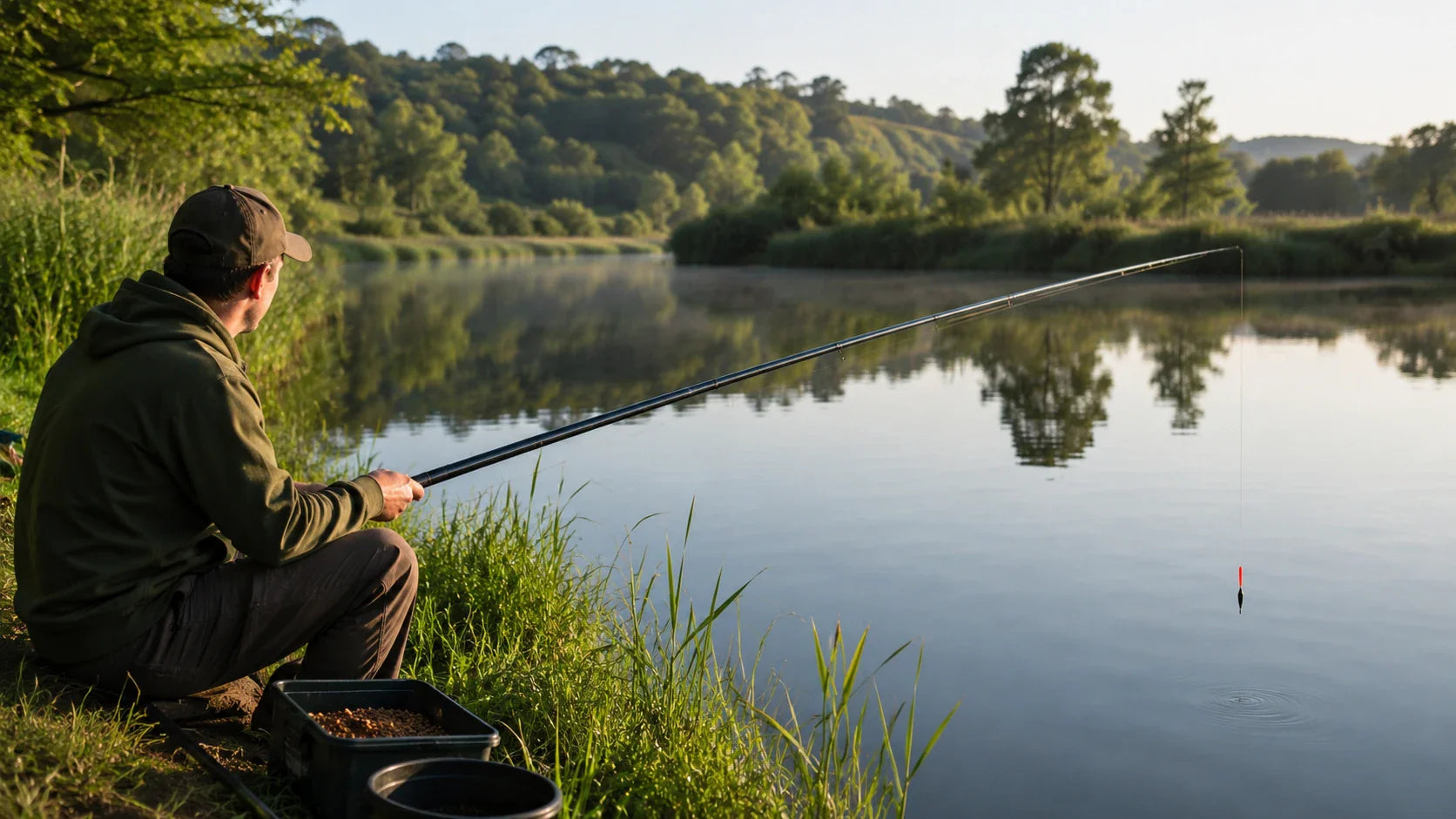
The first time I watched a match angler fish a pole properly, I couldn't understand what I was seeing. The rod was 13 metres long, the float was the size of a matchstick, and the fish were coming out one after another in a rhythm I'd never seen with a rod and reel. No casting, no reeling — just ship the pole out, lower the rig, wait, ship back, unhook, repeat. It looked effortless. It wasn't, of course. It just looked that way because the angler had spent years getting it right.
Pole fishing is the most precise method in coarse fishing. It gives you direct control over the rig that no rod and reel can match — you can hold the float absolutely still against a current, or move it in tiny increments to search a swim, or present a bait at exactly the depth you want with zero drift. Bob Nudd, four-time World Champion and one of the most decorated pole anglers in history, has built his entire career on the precision that pole fishing offers. This guide covers what you need to know to get started.
Pole vs Rod: The Fundamental Difference
A fishing pole has no reel. The line is attached directly to the tip of the pole via an elastic system, and the pole is extended or retracted to move the rig rather than casting and retrieving line. This gives you several advantages that a rod and reel can't replicate:
- Precise depth control: You can set the rig to fish at exactly the right depth and keep it there, regardless of current or wind. A rod and reel setup drifts; a pole doesn't.
- Delicate presentation: Pole rigs use tiny floats, fine hooklengths, and small hooks that would be impossible to cast on a rod. The result is a presentation that looks completely natural to wary fish.
- Direct bite detection: The elastic system transmits every movement of the float directly to your hand. Bites that would be invisible on a rod and reel are obvious on a pole.
- Speed: On a commercial fishery or a well-fed canal swim, a good pole angler can catch fish far faster than a rod and reel angler because there's no casting time — you ship out, lower the rig, and the float is fishing immediately.
Choosing the Right Pole Length
Pole length is the first decision, and it's determined by where you're fishing. Poles range from 4–5 metres (short margin poles for fishing right under the rod tip) to 16+ metres (competition poles for fishing at maximum range on large commercial fisheries).
For most Irish coarse fishing — canals, rivers, and club lakes — a 10–13 metre pole covers the vast majority of situations. On the Grand Canal or Royal Canal, most swims are fished at 8–11 metres. On a commercial fishery, you might need 13–16 metres to reach the far bank or the main channel. For a first pole, 10–11 metres is the most practical starting point — long enough for most situations, short enough to be manageable.
Whips — short, fixed-line poles of 3–6 metres — are a separate category used for catching small fish quickly at close range. They're excellent for beginners learning the basics of pole fishing because they're cheap, simple, and very effective for roach and small perch on canals and rivers.

Shakespeare Firebird Match Rod 10ft
A 10ft, three-piece float-fishing rod. This offers a rod-and-reel alternative to a fixed-line pole; a reel and suitable line are selected separately.
The Elastic System: The Most Important Detail
The elastic inside the top sections of the pole is what absorbs the runs of a fish. Without elastic, the direct connection between the pole and the fish would snap the line or the pole tip on every take. Getting the elastic right is the most important technical aspect of pole fishing.
Alan Scotthorne — five-time World Champion and one of the most technically precise match anglers in the world — has written extensively about elastic care. His key observation: "Expensive hollow elastic exposed to direct sunlight will perish much quicker than elastics protected inside the pole section." He recommends using hook-up devices to keep the elastic stored inside the top kit when not fishing, protecting it from UV damage that can halve its lifespan.
Elastic is rated by number — lower numbers are softer (for small fish), higher numbers are stiffer (for large carp). The table below gives the standard guidance:
| Elastic Grade | Target Species | Hook Size |
|---|---|---|
| 4–6 | Small silverfish (roach, rudd) | Size 18–24 |
| 6–8 | General silverfish, bream, small F1s | Size 16–20 |
| 8–10 | Bream, F1s, small carp | Size 16–20 |
| 10–12 | Larger F1s, small to medium carp | Size 14–18 |
| 14–16 | General carp, medium to large fish | Size 12–16 |
| 18–20 | Large carp, snaggy conditions | Size 10–14 |
Pole Floats: The Precision Instruments
Pole floats are completely different from waggler or stick floats. They're tiny, sensitive, and designed to show the most delicate bites. The float is attached to the line at both the top and bottom (a "double rubber" attachment), which gives it stability and allows it to be fished at a precise depth without moving.
The key specifications are the body shape and the wire stem. A round body float is more stable in choppy or windy conditions. A slim, elongated body is more sensitive in calm water. A wire stem sinks the float more positively and gives a crisper bite indication. For most Irish canal and lake fishing, a slim-bodied float with a wire stem in the 0.2–0.5g range covers the majority of situations.

Preston Innovations F1 Maggot Pole Float
€2.75
A specialist pole float from Preston Innovations — one of the most respected names in match fishing. Designed specifically for maggot fishing for F1s and silverfish, with a sensitive tip and wire stem that gives crisp bite indication. Ideal for commercial fisheries and pressured canal venues.
Rigs: Pre-Tied vs Building Your Own
A pole rig consists of the float, the shot pattern (olivettes and droppers), and the hooklength. For beginners, pre-tied rigs are the most practical starting point — they're correctly balanced, reliably tied, and save the considerable time it takes to learn to tie your own. As you develop, building your own rigs gives you the ability to fine-tune every element for specific conditions.
The standard shot pattern for most pole fishing is an olivette (a bulk weight) positioned about two-thirds of the way down the rig, with two or three small dropper shots below it. The olivette gets the rig down quickly to the feeding depth; the droppers control the final presentation and show bites by moving when a fish takes the bait.

Preston Innovations Power Pole Rigs
Ready-tied pole rigs with a choice of float capacities. Choose the capacity for your swim, depth and bait; check the rig’s hook and line specifications rather than assuming it matches a separate 15cm hooklength.

Preston Innovations Stotz Shot Top-Ups
Stotz top-up weights for adjusting a float rig. Choose the required size for your shotting pattern. The separate sizes let you replenish the weights you use most often.
Feeding: The Skill That Separates Good Pole Anglers from Great Ones
Bob Nudd's most consistent piece of advice across decades of coaching and competition is about feeding: "The secret is always in the way that you feed the fish." Pole fishing rewards a disciplined, consistent feeding approach more than almost any other method. The principle is "little and often" — small amounts of bait introduced regularly to keep fish in the swim and competing for food, rather than a large introduction that fills them up and kills the swim.
On a canal or river, loose feeding maggots or casters with a catapult every 60–90 seconds is the standard approach for roach and bream. On a commercial fishery targeting carp and F1s, feeding pellets with a pole cup (a small cup that clips to the pole tip and deposits bait directly over the rig) gives you more precision than a catapult.
The Complete Pole Fishing Setup
Beyond the pole itself, a productive pole fishing session requires a few essential pieces of equipment:
- Seat box: A stable seat box with a side tray for rigs and bait is the standard for any serious pole angler. It keeps everything organised and at the right height for comfortable fishing.
- Keepnet: For match fishing or when you want to weigh your catch, a quality keepnet that holds fish safely is essential.
- Pole rollers: Supports that hold the pole as you ship it out and back. Without rollers, shipping a 13-metre pole is exhausting and risks damaging the sections.
Seat-box supports and accessories
Browse supports and accessories for a seat-box setup. Check attachment dimensions and compatibility with your own box; an accessory listing is not a complete seat box.

Shakespeare Challenge XT Keepnet
A 3m keepnet range with round and square options. Check the selected shape and your fishery’s keepnet requirements before ordering.
Browse our full range of pole fishing gear at Emerald Ripple: whips, pole floats, coarse hooks, hooklength line, olivettes, split shot, pole accessories, keepnets, and seat boxes.