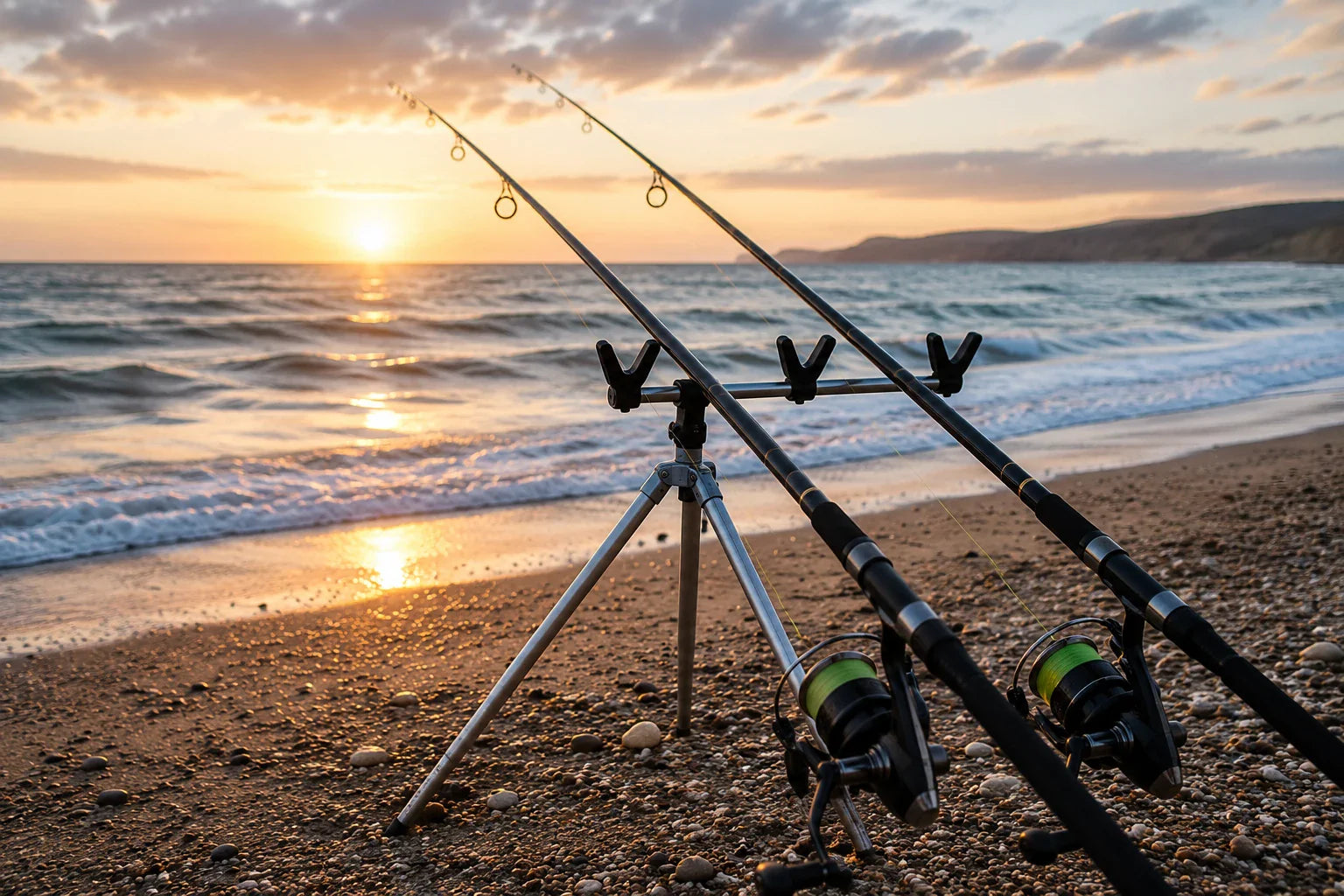
Standing on an Atlantic beach with the wind in your face and the waves crashing over the shingle is one of the most raw and rewarding ways to fish in Ireland. But the distance between where you're standing and where the bass, flatfish, and rays are feeding often looks impossible to cross. The truth is, skilled surf casters can put a bait exactly where it needs to be — but it takes the right tool to do it.
I've seen too many anglers struggle with "broomsticks" that are impossible to compress, or light spinning rods that fold in half against a 4oz lead. Choosing a surf fishing rod isn't just about buying the longest piece of carbon you can find. It's about matching the length, action, and casting weight to the marks you fish and the physical effort you're willing to put in.
Length: Why Longer Isn't Always Better
When you walk into a tackle shop, the temptation is to buy a 15ft rod because you assume it will cast further. That's a mistake. A rod only casts as far as you can compress (bend) it during the cast. If you don't have the technique or physical strength to compress a 15ft rod, you will actually cast further with an 11ft or 12ft rod that you can load properly.
9–11 foot rods: This is the sweet spot for active fishing. If you're casting and retrieving lures, working metal jigs, or fishing close-in gullies for bass, a 10ft rod is ideal. Henry Gilbey, one of the UK and Ireland's most respected surf lure anglers, frequently champions rods in the 9'6" to 10' range for surf fishing. As he puts it, it's not just about distance — it's about the efficiency of casting repeatedly into hectic conditions without tearing your shoulders apart.
12–13 foot rods: The standard all-round beachcaster. This length gives you the leverage to cast a 4–6oz lead and a large bait past the breaking surf, while keeping the line high enough above the waves to prevent the undertow from dragging your rig out of position. If you're buying your first dedicated bait-fishing surf rod, 12ft is where you start.
14–15 foot rods: These are specialist tools for extreme distance casting, often used with pendulum casting techniques. They require serious technique to use effectively. If you're fishing shallow, shelving beaches where the fish are holding 100+ yards out, this is what you need — but be prepared to practice your casting.

Mitchell Neuron Surf Rod
€45.00
An excellent entry-level beachcaster. It offers a forgiving action that helps beginners learn to load the rod properly, providing good distance without requiring perfect technique.
Casting Weight: Match the Lead to the Rod
Every surf rod has a casting weight rating printed on the blank — typically in ounces (e.g., 4–6oz) or grams (e.g., 100–200g). This isn't a suggestion; it's the specific weight range the rod is engineered to cast.
If you put a 2oz lead on a rod rated for 4–8oz, the rod won't bend during the cast. You're effectively casting with a broomstick, and your distance will be terrible. Conversely, if you put an 8oz lead on a rod rated for 2–4oz, the rod will "bottom out" (bend as far as it can go) before you've finished the casting stroke, killing your distance and risking a snapped blank.
For most Irish surf fishing — targeting bass, flounder, and dogfish — a rod rated for 4–6oz (110–170g) is perfect. It handles the lead needed to hold bottom in a moderate surf, plus the weight of a crab or mackerel bait.

Kinetic Wave Blaster CT Beachcaster
€149.99
A serious tool for rough conditions. Built to punch heavy leads into Atlantic headwinds, this rod generates massive tip speed while retaining enough sensitivity to show bite registration in the surf.
Action: Fast vs. Moderate
Surf rods behave similarly to fly rods in how they load. A fast-action rod bends mostly in the top third. It recovers quickly and punches leads out with a sharp, aggressive casting stroke. However, it's unforgiving — if your timing is off, the cast fails. Fast action rods are also less ideal for soft baits like peeler crab, as the aggressive acceleration can rip the bait off the hook.
A moderate-action rod bends deeper into the blank. It loads more slowly and smoothly, which makes it far easier for the average angler to cast effectively. It's also much kinder to soft baits. For 90% of anglers fishing bait from the shore, a moderate or progressive action rod is the right choice.
The Reel and Line Setup
A great rod is useless without the right reel and line. For surf fishing, you have two choices: a large fixed-spool spinning reel (often called a surf reel) or a multiplier.
Multipliers offer ultimate distance in the hands of an expert, but they require an educated thumb to prevent massive tangles (bird's nests). Modern fixed-spool surf reels with large, tapered spools can cast almost as far as multipliers and are vastly easier to use, especially at night or in cold weather.

Kinetic Tavon Surf Reel 7000
€27.99
A large-capacity surf reel designed to handle the heavy lines and aggressive casting of beach fishing. The large spool diameter helps line peel off smoothly for maximum distance.
For mainline, monofilament in 15–20lb is traditional and highly abrasion-resistant against sand and shingle. However, many modern surf anglers are switching to braided line (around 30lb). Braid has a much thinner diameter, which cuts through the surf and wind far better than mono, preventing your lead from being dragged out of position. Because braid has no stretch, bite detection at 100 yards is instantaneous.
Crucial Rule: Whatever mainline you use, you MUST use a shock leader. When you cast a 5oz lead, the force generated will snap 15lb line instantly. The rule of thumb is 10lb of shock leader for every 1oz of lead. If you're casting 5oz, you need a 50lb monofilament shock leader tied to your mainline, long enough to wrap around the spool five or six times with the lead hanging from the rod tip.
Final Thoughts for the Beach
Surf fishing is about reading the beach as much as it is about casting. Look for gullies, sandbanks, and areas where the wave pattern changes — these are the features that hold fish. Often, the bass are feeding right in the first breaker, just 20 yards from your feet. Don't cast to the horizon until you've checked the water right in front of you.
Browse our full range of Surf Rods, Surf Reels, Lines, and terminal tackle at Emerald Ripple to build the perfect setup for the Irish coast.