
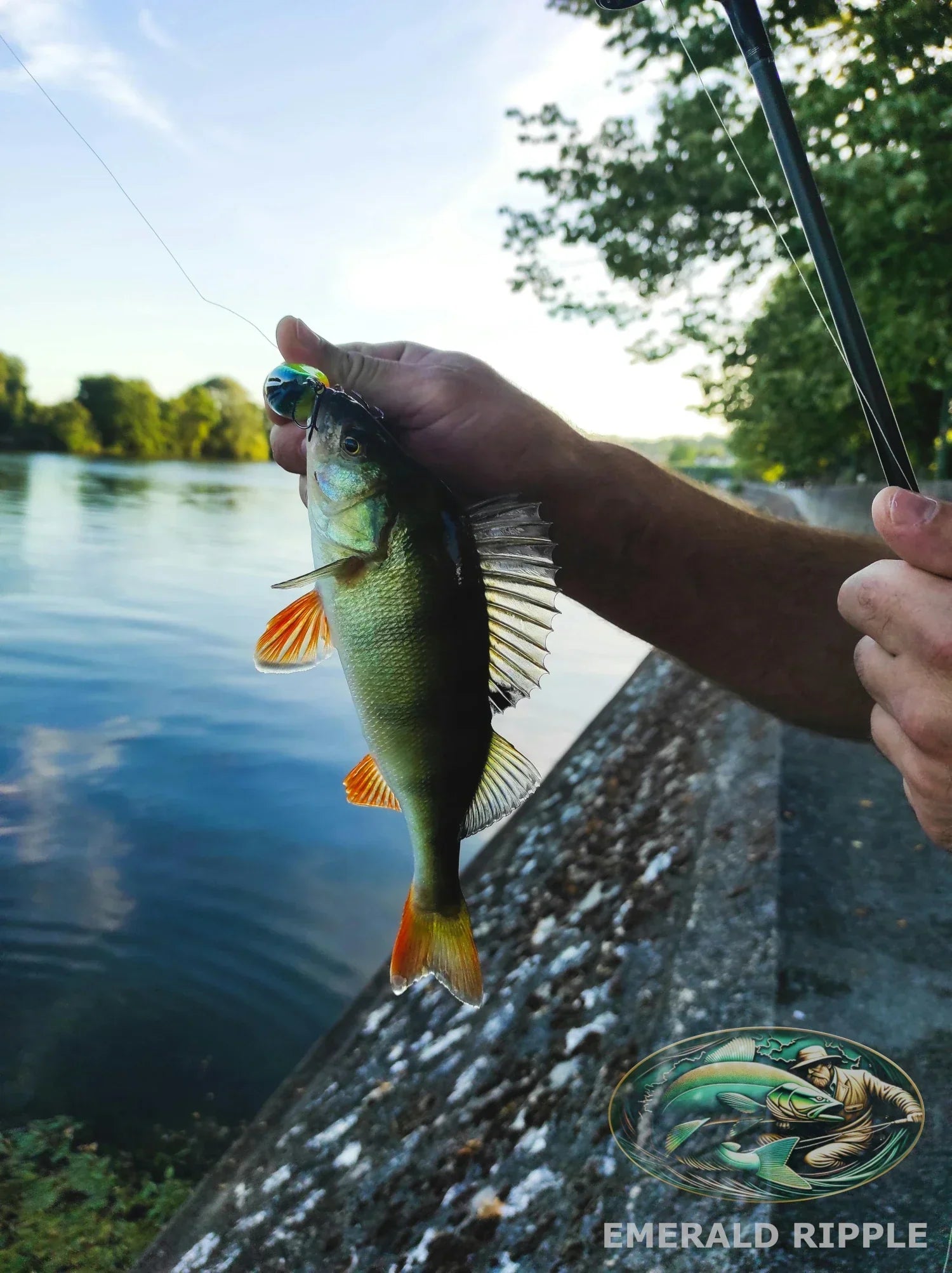
I'll be honest — the first time I went after perch with spinners, I came home with nothing but a tangle of line and a bruised ego. I'd grabbed whatever was in the tackle box, chucked it out, and expected the fish to do the rest. They didn't. It took a few more blank sessions before I started paying attention to what was actually going on beneath the surface.
Perch are one of those fish that reward you when you think like they do. They're not random — they have habits, favourite spots, and they respond to very specific triggers. Once I figured that out, things changed fast.
Where Perch Actually Hide
Perch aren't out in open water waiting for you. They sit tight to structure — tree roots, sunken branches, weed edges, areas where the current slows and reverses. I've had my best sessions in spots that looked almost too obvious: a fallen tree half-submerged on the far bank, a patch of lily pads with a clear gap in the middle, a deep hole just downstream of a bridge pillar.
In summer they push shallow and hunt insects near the surface, especially in the early morning. By autumn they drop deeper and pack into tighter groups — find one and you'll often find a dozen. That's when heavier presentations come into their own, because you need to get down to where they're sitting.
Why Spinners Beat Live Bait More Often Than Not
I used to think live bait was always the safer bet. It isn't. With spinners you can cover water quickly, adjust depth on the fly, and experiment without having to dig around in a bait box every five minutes. If one retrieve speed isn't working, you speed up. If a silver blade isn't triggering takes, you switch to copper. You just can't do that with a worm on a hook.
There's also the size factor. The biggest perch I've ever caught — a solid fish over 2lb — came on a spinner worked slowly along the bottom of a deep pool. A float rod with maggot would never have reached it.
Picking the Right Spinner
This is where most people overthink it, and I was no different. The honest answer is: you need a few different options and you let the fish tell you what they want on the day.
Weight matters more than most people realise. For perch, I've found the 9–11g range hits the sweet spot — heavy enough to cast accurately and fish at depth, light enough to flutter and wobble on a slow retrieve. Go too light and the wind ruins your presentation; go too heavy and the blade won't spin freely.
Blade shape changes how the lure behaves in current. In slow rivers or still lakes, a wide oval or petal-shaped blade gives you that lazy, thumping action that drives perch mad. In faster water, switch to a narrower, longer blade — it tracks better and doesn't get pushed around.

Abu Garcia Droppen Spinners 6g — Matte Fluo Pink
€5.79
A compact, well-balanced spinner that casts accurately and produces a reliable blade action at slow retrieve speeds. The fluo pink colour is a proven perch trigger in coloured water.

Berkley Pulse Spintail 5g — Sambal Ayu
€6.60
A tail spinner that combines the flash of a blade with the profile of a small baitfish. Deadly for perch on a slow, steady retrieve just above the bottom.
Browse the full range of Spinners and Spinnerbaits at Emerald Ripple.
Colour: The One Variable That Changes Everything
Red is the one colour I always have on me — there's something about it that triggers an aggressive response in perch, especially in slightly coloured water. In clear conditions I lean towards silver or nickel. In low light — early morning, overcast days, evening sessions — black or dark bronze can be surprisingly effective near the bank.
- Choose spinners with red elements as a starting point — perch are consistently attracted to this colour across all seasons.
- In clear, bright conditions: silver, nickel, or natural baitfish patterns.
- In coloured or murky water: bright chartreuse, orange, or fluo pink.
- At dawn, dusk, or in low light: dark bronze, black, or dark motor oil.
- Spring baits should be bright enough to attract attention in cold, often coloured water.
A Quick Quality Check Before You Buy
I've bought cheap spinners that fell apart on the first cast, and it's a waste of money and time. Before anything goes in my box, I check:
- The blade spins freely with no sticking — hold it up and give it a flick with your finger.
- No chips, rust, or flaking paint on the body.
- The central wire is straight and has no kinks.
- Hooks are sharp — run one across your thumbnail, it should catch, not slide.
- Blade material is nickel silver, brass, copper, or silver — not cheap pressed tin.
8 Things I Wish Someone Had Told Me Earlier
- Always carry something red. Perch respond to it consistently across seasons — a red tail, a red bead, a red-tipped blade.
- Match the size to the prey. Small perch in a river full of fry? Use a 4–5cm spinner. Targeting big fish in a deep reservoir? Go 10–11cm.
- Use a long swinging blade without a snap for most situations. The action is more natural and the vibration carries further.
- Ball or cone sinkers cast further. If you need distance on a wide river or large lake, a spinner with a shaped sinker will outcast a flat-bodied one every time.
- Narrow blades for fast water. A wide blade in a strong current just spins out of control. Go narrow and keep it tight to the bottom.
- Oval blades make noise. The irregular rotation creates a thumping vibration that perch can detect from a surprising distance — useful in coloured or deep water.
- Petal-shaped, 11g spinners are my go-to for still water. They sink slowly, flutter on the drop, and the wide blade catches light from every angle.
- Change colour with the light. Bright and flashy in daylight, dark and subtle in low light.
The Setup: Rod, Reel, and Line
A decent spinning rod in the light to medium range (rated 5–20g) is all you need for perch spinner fishing. Anything heavier and you lose the feel of the blade working; anything lighter and you can't cast the 9–11g spinners that reach the fish holding at depth.

Abu Garcia Cardinal X Spinning Reel
€28.00
A reliable, smooth-running spinning reel that pairs perfectly with a light spinning rod for perch fishing. Consistent drag and a well-balanced rotor make slow retrieves easy to control.
For line, monofilament in the 6–8lb range is the standard for spinner fishing — it has enough stretch to absorb the shock of a hard take and is forgiving of imperfect knots. If you want more sensitivity and direct connection to the blade, braided line with a short fluorocarbon leader is worth trying once you're comfortable with the technique.
Replace your treble hooks at the first sign of rust or blunting — a sharp hook is the single most important factor in converting follows into landed fish. Browse our full range of spinners, spinning rods, spinning reels, and lines at Emerald Ripple.