
There's an old saying that floats around fishing circles — "all tackle is replaceable." And in a pinch, sure, there's some truth to it. I've rigged up a makeshift rod from a hazel branch more than once on a spontaneous riverside session. I've improvised with whatever line I had to hand. But a hook? That's where the logic falls apart. You can't bluff a fish with a bent bit of wire and expect much to happen. The hook is the one point of contact between you and the fish — everything else is just delivery.
Twenty Thousand Years of the Same Basic Idea
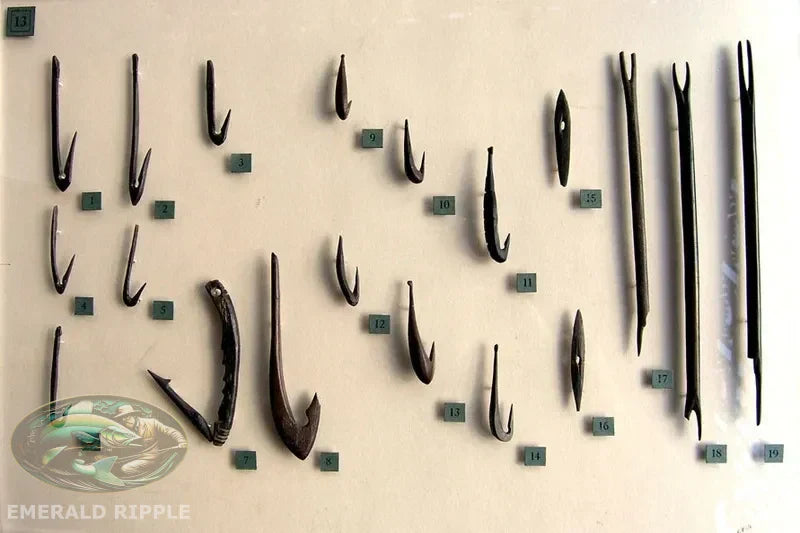
What strikes me most about hooks is how old the concept is. Archaeological evidence suggests humans were using purpose-made hooks somewhere around 20,000 years ago — long before writing, long before agriculture, long before most of what we consider civilisation. Fragments found in Egypt and China show that by the time those cultures were flourishing, the hook was already a well-established tool with a long history behind it.
The earliest versions weren't what we'd recognise today. They were more like gorges — straight or slightly curved pieces of bone, wood, or shell that the fish swallowed along with the bait, then lodged sideways in the throat when the line was pulled taut. Crude by modern standards, but effective enough that variations of this design were still being used for eel fishing well into recent centuries.
The shift toward the curved hook we know today is often credited to someone — no one knows exactly who — who heated a sewing needle, bent it into a curve, filed a barb into the shank, and sharpened the point. The Chinese emperor Qin Gu reportedly described this technique in the second century AD, which gives you some sense of how long ago people were already refining the idea.
What Hooks Were Made From (And Why It Matters Now)
Before industrial manufacturing made steel the obvious choice, hooks were carved, cast, and shaped from whatever was available — wood, animal horn, chitin, bone, mother-of-pearl, bronze, brass, copper, and occasionally gold or other precious metals. In ancient Greece and Rome, iron and bronze were the standards. Each material had its trade-offs: bone was light but brittle, bronze held an edge but corroded, copper was easy to work but soft.
By the Middle Ages, the hook had become genuinely important — not just as a fishing tool but as a symbol of trade and survival. In parts of Europe, hook-makers were respected craftsmen who incorporated the hook into their guild coats of arms. By the 17th century in the Netherlands, there were professional fishermen who specialised entirely in hook-and-line fishing, treating it as a dedicated trade rather than a subsistence activity.
It's a strange thought — that something sitting in your tackle box today carries that kind of history. But it's also a useful reminder that the hook has been refined over an enormous span of time. What we have now is the product of thousands of years of trial and error.
Choosing the Right Hook Today
Modern hooks are made from high-carbon steel, stainless steel, or chemically sharpened alloys, and the range available is genuinely vast. The choice you make matters more than most anglers give it credit for.
For general coarse fishing and carp work, single hooks are the standard — available in a huge range of sizes, patterns, and wire gauges. Within that category, carp hooks are designed with a heavier wire and a specific bend geometry to handle the power of a big fish without straightening, while coarse hooks tend to be finer in the wire for more delicate presentations.
For predator fishing — pike, perch, zander — treble hooks are the go-to for lure work, giving you three points of contact on a fast-moving strike. Offset hooks have become increasingly popular for soft lure fishing, particularly with weedless rigs where a standard hook would snag constantly.
If you're tying your own rigs or flies, fly tying hooks are a category in themselves — the wire weight, gape, and shank length all affect how the finished fly sits and moves in the water.
For those who prefer to skip the tying and get straight to fishing, ready rigs and carp rigs are worth a look — pre-tied on quality hooklength line and ready to clip straight onto your mainline.
The One Check That Saves Sessions
I've lost good fish because I didn't check my hook point before casting. It takes five seconds: drag the point lightly across your thumbnail. If it catches and digs in slightly, it's sharp. If it slides, it's blunt — either sharpen it with a hook sharpener or swap it out. A blunt hook is the single most common reason for missed takes, and it's entirely preventable.
Beyond sharpness, check for rust, bent points, and any sign that the barb has been damaged. A hook that looks fine from a distance can have a micro-crack or a flattened barb that you'll only discover when a fish shakes free at the net.
It's Still the Most Important Piece of Tackle You Own
Everything else in your setup — the rod, the reel, the line, the lure — exists to put the hook in the right place at the right time. The hook is what actually catches the fish. Spend a bit of time choosing the right pattern and size for what you're targeting, check the point before every session, and don't try to save money on the one piece of tackle that matters most.
Browse our full range of hooks — including single hooks, treble hooks, offset hooks, jig heads, and stingers — at Emerald Ripple.