
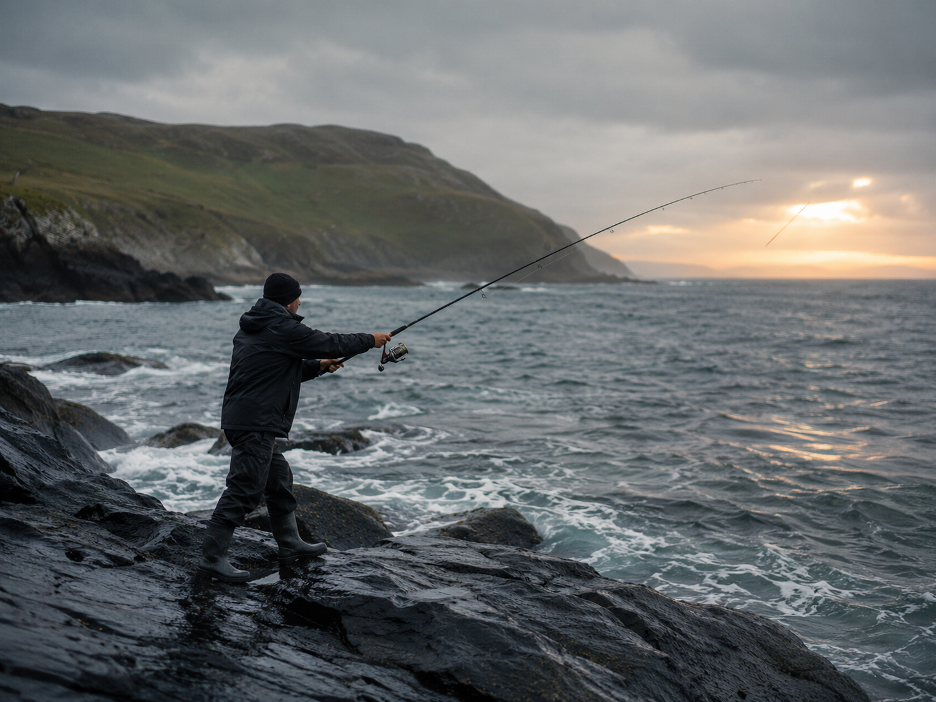
Most blank sessions in Ireland are lost in the kitchen, not on the bank. The wind was wrong for the mark, the tide had already turned, or the lough had three feet of colour in it after Tuesday's rain — and none of that was a surprise to anyone who checked first. Modern anglers handle this with an all-in-one fishing app that puts maps, bite forecasts, hourly weather, tides and a catch log on a single screen, instead of stitching the picture together from four browser tabs at seven in the morning.
But the app is only as good as the angler reading it. Here's what actually matters on Irish water, and what to do with each piece of information once you have it.

The Wind Tells You Where, Not Whether
Ireland's prevailing wind is south-westerly, straight off the Atlantic, and the standard reaction to a windy forecast is to stay home. That's usually the wrong call. Wind is a location problem, not a cancellation.
On the big western loughs — Corrib, Mask, Derg — a steady wind pushes surface food and fry against the downwind shore, and predators follow. The lee bank looks inviting and comfortable, and it's often the emptier water. Wading into a chop is unpleasant, but a decent onshore breeze is doing your chumming for you.
The same logic works in reverse on the coast. A hard onshore wind piling into an exposed western mark makes it unfishable and genuinely dangerous. Move to the sheltered side of a headland or into an estuary and the same weather system becomes an advantage: coloured, oxygenated water and fish feeding close in.
Two practical thresholds worth remembering. Under about 15 km/h, most marks fish normally and you can work light lures with control. Over roughly 35 km/h, casting accuracy collapses and you should be choosing your venue for shelter, not for fish. Between those two numbers is where the good sessions live — and where casting weight matters. Bumping from a 7–28 g rod up to something rated to 40 g, or switching from a light spoon to a compact metal jig, is often the difference between fishing the wind and fighting it.
Pressure: The Number Most Anglers Skip
Barometric pressure gets dismissed as folklore, but plenty of experienced anglers plan around it, and the reasoning is sound enough: fish carry a swim bladder, and rapid pressure changes affect their buoyancy and comfort in the water column.
What most people report on Irish water:
● Falling pressure, in the hours before a front arrives, often produces the best feeding of the week. If you can only fish one window, this is it.
● Steady low pressure — the classic soft, grey, drizzling Irish day — tends to fish well and consistently. Overcast light also keeps predators higher in the water and less spooky.
● Sharp rising pressure after a front has cleared through is usually the hardest. Bright, still, high-pressure days look glorious and fish miserably. Go deeper, go smaller, go earlier.
The trend matters far more than the absolute reading. A barometer sitting at 1015 and dropping is a very different day from 1015 and climbing, even though the number on the screen is identical. This is precisely the kind of thing worth checking the night before rather than the morning of — by the time you're at the water, the decision has already been made for you.

Tides: Two Hours Beat Six
For anyone fishing the coast or an estuary, the tide is not one factor among several — it's the schedule everything else hangs off. Irish tidal ranges are substantial, roughly four metres in many places and more on springs, which means a mark can go from perfect to bone dry inside three hours.
The reliable rule: fish the two hours either side of the turn. Moving water pushes bait through channels and gullies, and predators sit and wait for it. Slack water at the top or bottom of the tide is generally the quietest part of the cycle, and it's when most anglers who "fished all day" were actually just standing there.
Spring tides — around the new and full moon — bring bigger movement, stronger currents and more colour. That suits bass and rays on surf beaches but can make finesse work impossible. Neaps are gentler, clearer, and better for lighter tactics and careful presentation.
One safety point that matters more than any of the above: on rock marks and sandbars, know your tide times before you go, not after you notice the water behind you. Every season this catches people out.
After the Rain: Colour, Level and Lure Choice
Ireland gets rain, and rivers respond fast. Reading the aftermath is a genuine skill.
A river in full flood, the colour of milky tea, is usually not worth your morning. But the dropping and clearing stage a day or two later is often the best fishing of the month — the water still carries food, the fish are still switched on, and visibility has come back enough for them to find your lure.
Match your presentation to the visibility you actually have:
● Heavily coloured water: big profile, strong vibration, dark silhouettes. Spinnerbaits, large soft plastics, anything that pushes water. Chartreuse and black earn their keep here.
● Peat-stained water — the tea-coloured bog water common across the midlands and west — behaves differently from mud. It's dark but often quite clear. High-contrast and metallic finishes work better than you'd expect.
● Clear, low water: downsize hard. Natural patterns, fluorocarbon leader, longer casts, and accept that you'll be fishing dawn and dusk rather than the middle of the day.
Putting It Together the Night Before
A workable session plan takes about five minutes:
1. Check wind speed and direction → pick the venue and the bank.
2. Check the pressure trend, not the number → decide your window.
3. Check the tide, if coastal → set your arrival time around the turn.
4. Check rainfall over the last 48 hours → predict colour, choose lures accordingly.
5. Pack for the day you'll actually get, not the one you hoped for.
The reason this rarely gets done properly isn't laziness. It's that the information lives in five different places — a weather site, a tide table, a river-level page, a map, and whatever you scribbled in your notes last autumn. By the third tab, most people give up and just go.
That fragmentation is the real problem, and it's why consolidation matters more than any single feature. When hourly weather, pressure trends, tide times, solunar periods, marked spots and your own catch history sit in one dashboard, the five-minute plan actually happens. Fishbox was built around exactly that idea — one screen instead of five tabs — and it also keeps a searchable log of your sessions, so after a season you stop guessing which conditions produce for you and start knowing.

The Short Version
Irish conditions change quickly, and that's genuinely an advantage once you stop treating the weather as an obstacle and start treating it as information. Wind tells you which bank to stand on. Pressure tells you which day to take off work. Tide tells you which two hours to be there. Rain tells you what to tie on.
Get those four right and you'll fish fewer sessions but blank far less often — and the gear in your bag will finally be matched to the water in front of you rather than the water you imagined on Thursday night.