
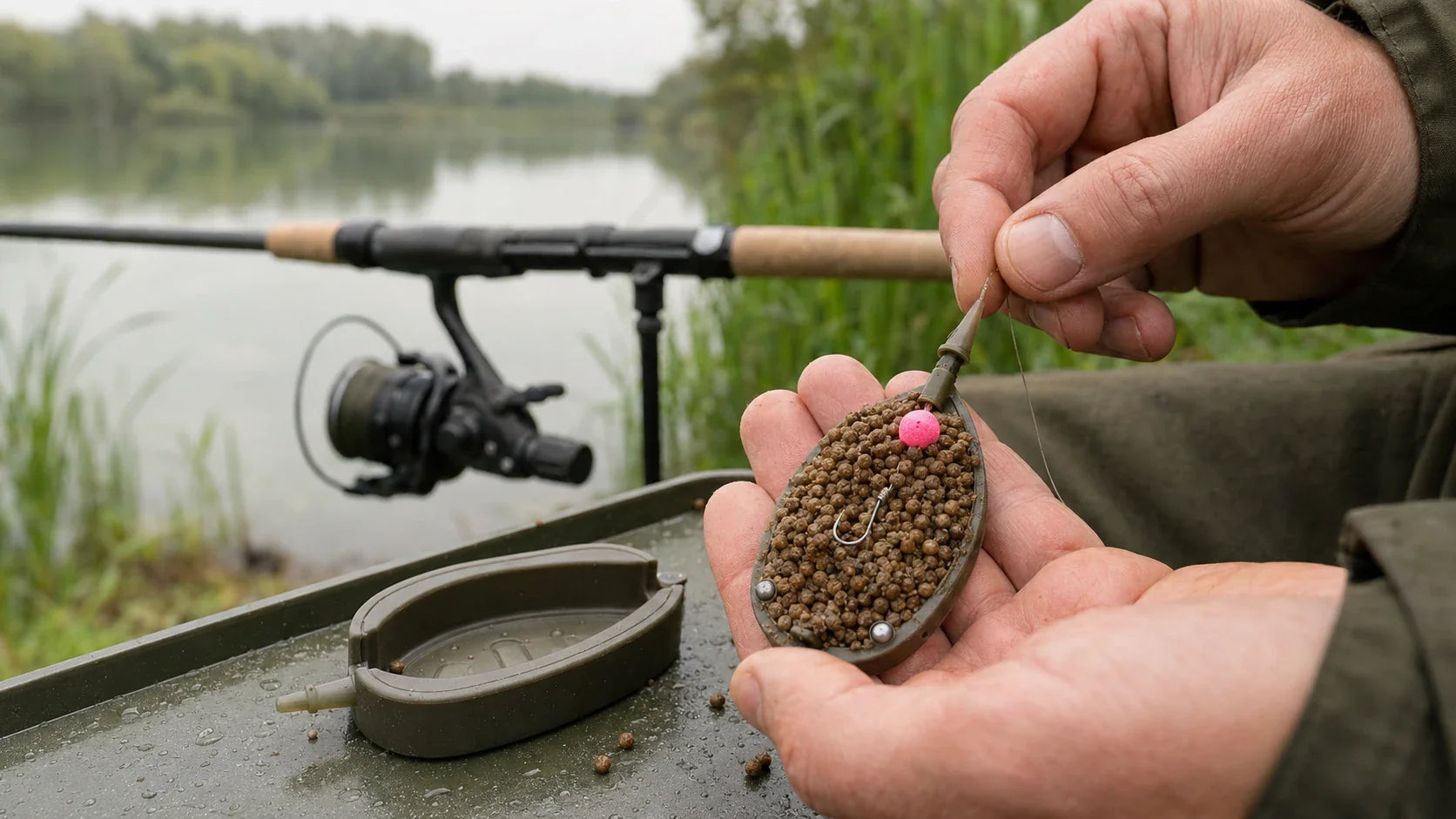
The method feeder has transformed the way anglers target carp on commercial fisheries and natural waters. Instead of spreading loose feed across a wide area, it delivers a compact parcel of pellets or groundbait with the hookbait positioned directly in or on top of the feed. When a carp investigates the feeder, the hookbait is presented among the free offerings, where it can be taken naturally. The weight of the feeder then helps the hook take hold as the fish moves away.
The principle is simple, but a successful method feeder setup depends on several important details. The feeder must be assembled safely, the hooklength must be short enough, and the feed must remain attached during the cast while still breaking down quickly on the bottom. This guide explains how to set up a method feeder for carp, how to prepare pellets and groundbait, which hookbaits work best, and how to avoid the mistakes that commonly cost anglers fish.
What You Need for a Method Feeder Setup
A basic carp method feeder setup consists of an inline flatbed method feeder, a compatible method feeder mould, a quick-change bead or swivel, a short hooklength, a suitable hook with a hair or bait band, micro pellets or method groundbait, a hookbait such as a wafter or pellet, a feeder rod with a sensitive quivertip, and a suitable reel loaded with sinking monofilament line.
Whenever possible, use components from the same feeder system. Feeders, stems, beads, connectors and moulds are not always interchangeable between different brands or sizes.
Understanding the Method Feeder Rig
Most modern method feeder rigs use an inline feeder with a weighted base. The mainline passes through the centre of the feeder and connects to a compatible swivel or quick-change bead. The connector normally sits inside the feeder stem, creating enough resistance for the weight of the feeder to help set the hook. However, the rig must still remain fish-safe. Use the feeder exactly as the manufacturer intends and make sure it can move freely or separate safely if the mainline breaks. Avoid improvised, permanently fixed arrangements, and always check the rules of the fishery before fishing.
A short hooklength is one of the most important parts of the setup. For most commercial carp fishing, a hooklength of approximately 3–4 inches (7.5–10cm) is a good starting point. The short hooklength keeps the hookbait close to the feeder after the pellets or groundbait begin to break down. A longer hooklength can leave the bait sitting away from the main pile of feed and may reduce the effectiveness of the presentation. Some fisheries specify permitted hooklength lengths, so always check the local rules.
How to Set Up a Method Feeder Step by Step
1. Choose the Right Feeder
Select the feeder according to the distance, depth and amount of feed you want to introduce. A standard flatbed method feeder is ideal for short- and medium-range fishing. A distance feeder has a more aerodynamic profile and is better suited to longer casts or fishing into a headwind. A Banjo-style feeder carries a smaller, protected parcel of bait and can be particularly effective when the fish respond better to a compact feeding area. Choose a feeder weight that your rod can cast comfortably — the feeder will become considerably heavier once loaded with pellets or groundbait.
| Fishing situation | Recommended feeder type |
|---|---|
| Short- to medium-range commercial fishing | Standard flatbed method feeder |
| Long casts or strong headwinds | Distance method feeder |
| Small, compact parcel of feed | Banjo or hybrid-style feeder |
| Cold water or cautious fish | Smaller, lighter feeder |
| Deep water or difficult conditions | Heavier feeder within rod's casting rating |
For standard commercial work, the Preston Innovations ICS In-Line Dura Flat Method Feeder is a strong starting point. For longer casts, the Preston Innovations ICS In-Line Distance Method Feeder provides a more aerodynamic profile. When you want to present a smaller and more protected parcel of feed, the Preston Innovations ICM In-Line Banjo XR Feeder is another useful option.
2. Thread the Feeder onto the Mainline
Pass the mainline through the centre tube or stem of the feeder, following the instructions for the particular feeder system. Check that the line moves smoothly and has not been damaged by the feeder or any sharp edges.
3. Attach the Connector
Tie the mainline to the recommended quick-change bead, connector or swivel. Use a reliable knot, wet it before tightening and trim the tag end carefully. Pull the connector into the feeder stem only as firmly as the manufacturer recommends — it should provide enough resistance for the rig to work correctly without creating an unsafe, permanently fixed setup.
4. Attach a Short Hooklength
Connect a hooklength approximately 3–4 inches long. Pre-tied method feeder hooklengths are convenient, but you can also tie your own. Hook sizes between approximately 12 and 16 are commonly used for commercial carp fishing, depending on the size of the hookbait and the fish being targeted. The hooklength can be attached using the loop-to-loop method or a quick-change connector, depending on the feeder system.
5. Attach the Hookbait
The hookbait should normally sit just below the hook rather than being placed directly on the hook itself. Depending on the bait, you can use a hair rig for boilies, wafters and drilled pellets; a bait band for hard pellets; a bayonet for wafters and soft hookbaits; or a quick stop for sweetcorn, meat and other soft baits. Make sure the bait sits close enough to the hook for effective hooking without restricting the movement of the hook.
6. Check the Rig Before Casting
Before loading the feeder, check that the hooklength is not twisted or damaged, the hook point is sharp, the connector is correctly seated, the feeder can operate safely if the mainline breaks, the hookbait attachment is secure, and the feeder weight is suitable for the rod. It is also worth testing the complete setup in the margin — this allows you to see how quickly the feed breaks down and how the hookbait behaves once released.
Recommended Method Feeders and Moulds
Modern flatbed feeders have a weighted base that helps them land with the feed facing upwards, keeping the hookbait accessible rather than trapping it underneath the feeder. A method mould makes loading the feeder faster and more consistent. The Matrix Squeeze & Feed Method Mould and the Preston Innovations Quick Release Method Mould are both reliable options. Always select a mould designed for the exact model and size of feeder you are using — do not assume that a mould from one brand or feeder system will fit another.
How to Load a Method Feeder Correctly
A method mould creates a consistent, aerodynamic parcel of feed that is less likely to break apart during the cast. Place the hookbait into the bottom of the mould first, then add the prepared pellets or groundbait. Position the feeder over the filled mould with the feeding surface facing downwards, press the feeder into the mould using firm, even pressure, and release the loaded feeder using the mould's release mechanism. Check that the feed is evenly packed and that the hookbait is positioned in or close to the top layer.
Choosing Between Pellets and Groundbait
Micro Pellets
Micro pellets, usually around 2mm, create a compact parcel of food without introducing too much bait. They are particularly effective on commercial carp fisheries. Sonubaits Fin Perfect Feed Pellets are well suited to this style of fishing. As a starting point, soak 2mm pellets for approximately two minutes, drain them thoroughly and allow them to rest until the remaining moisture has been absorbed. The exact preparation time depends on the pellet, water temperature and conditions — follow the manufacturer's instructions whenever they are available.
Correctly prepared pellets should stick together when pressed into the mould but separate easily when disturbed underwater. If the pellets are too dry, they may fall away during the cast. If they are too wet, they may become soft and sticky and remain trapped around the feeder for too long.
Groundbait
Groundbait is useful when you want to create a stronger scent cloud or adjust the texture of the feed more precisely. Fishmeal-based method groundbaits are a popular choice for carp. Add water gradually in several stages, mixing thoroughly after each addition. Allow the groundbait to rest so that the particles can absorb the moisture, then mix or riddle it again before use. The finished groundbait should hold its shape when squeezed but crumble easily when rubbed between your fingers. You can also combine micro pellets and groundbait — a light coating of groundbait can help pellets bind while adding extra flavour and attraction.
For more ideas about selecting hookbaits and loose feed, read our guide to the 16 Best Carp Baits to Use and When.
Selecting the Best Hookbait
The hookbait must be easy for the carp to pick up and should remain positioned close to the feeder as the free feed breaks down. Wafters are one of the most reliable method feeder hookbaits. A correctly balanced wafter sits lightly over the feed and reduces the effective weight of the hook, allowing the bait to enter the carp's mouth more naturally when the fish feeds around the feeder. The Sonubaits Spike'um Wafter 8mm is a compact and proven hookbait for this style of fishing.
Bright colours such as yellow, pink, orange and white can help the hookbait stand out against darker pellets or groundbait. However, on heavily pressured or clear waters, a natural or washed-out colour can produce more confident bites. Other effective method feeder hookbaits include hard pellets, mini boilies, dumbell wafters, sweetcorn, artificial corn, small pieces of luncheon meat, and maggots where fishery rules allow them. Experiment with colour, flavour and buoyancy until you find the presentation that the carp prefer on the day.
Rods, Reels and Mainline
For short- and medium-range method feeder fishing on commercial waters, a 10–11ft feeder rod with a progressive action is usually ideal. The softer action cushions sudden lunges and reduces the risk of hook pulls, particularly when using short hooklengths and relatively small hooks. For larger waters and longer casts, a more powerful distance feeder rod may be required. The Preston Innovations Monster Xtreme Distance Feeder Rod is designed for demanding long-range fishing, while the Matrix Aquos Ultra-D New Feeder Rod is another option for anglers looking for a dedicated feeder setup.
Pair the rod with a smooth reel that has a reliable clutch and enough line capacity for the venue. The Matrix Ethos XR Reel and Korum Zelos Distance Reel are both well-suited to feeder fishing. A sinking monofilament mainline of approximately 6–10lb breaking strain will cover many situations — the Preston Innovations Extremity Feeder Mono and Matrix Submerge XD Bulk Monofilament are reliable choices available in the monofilament line range. Braided mainline has very little stretch and may increase the risk of hook pulls when used with short hooklengths. Monofilament is normally the more forgiving option for commercial method feeder fishing.
Casting and Bite Indication
Accuracy is more important than repeatedly casting as far as possible. Method feeder fishing works best when each feeder lands in the same area and gradually builds a concentrated feeding spot. Use the reel's line clip once you have found the correct distance, and choose a visible marker on the opposite bank to maintain the same direction.
Use a smooth overhead cast and feather the line shortly before the feeder reaches the water. This helps the feeder enter the water in a controlled position and reduces tangles. Allow the feeder to reach the bottom before carefully tightening the line — avoid dragging it across the lakebed, as this can separate the feed from the feeder and move the hookbait away from the main parcel.
When the quivertip pulls around positively, lift the rod smoothly and begin playing the fish. A violent strike is unnecessary and can pull the hook free. During active feeding periods, recasting every 5–10 minutes can help build the swim. In colder water or when the fish are cautious, leaving the feeder for longer may be more effective.
Common Method Feeder Mistakes
Using feed that is too dry — dry pellets or groundbait may fall away during the cast or when the feeder hits the water. Making the mix too wet — an excessively wet mix can remain around the feeder as a heavy paste, preventing the hookbait from being presented correctly. Using an overly long hooklength — start with approximately 3–4 inches unless fishery rules require otherwise. Compressing the feed too hard — more pressure does not always produce a better feeder; over-compressed feed may take too long to release. Using an incorrect mould — a mould that does not match the feeder may produce an uneven parcel or fail to release the feeder cleanly. Choosing a feeder that is too heavy — remember that the casting weight includes both the feeder and the feed; always stay within the casting rating of the rod. Fishing with a blunt hook — check the point regularly and replace the hook whenever necessary. Casting to a different spot every time — use a line clip and a far-bank marker to maintain consistent distance and direction. Striking too aggressively — the weight of the feeder already helps the hook take hold; a smooth lift of the rod is normally enough.
Frequently Asked Questions
How long should a method feeder hooklength be?
A hooklength of approximately 3–4 inches (7.5–10cm) is a good starting point for most commercial carp fishing. Always follow the rules of the fishery.
Does the hookbait need to be buried inside the feeder?
It can be lightly covered, but it should normally be positioned in or close to the top layer of feed. This keeps it near the free offerings while reducing the risk of tangles.
Can I load a method feeder without a mould?
Yes, but a compatible mould produces a more consistent shape and makes accurate casting easier. Loading by hand can result in uneven pressure and an increased risk of the feed separating during the cast.
How often should I recast a method feeder?
During active feeding, try recasting every 5–10 minutes. In cold conditions or when the carp are cautious, extend the time between casts. Avoid recasting automatically if you are receiving indications.
Can I use braid for method feeder fishing?
Braid can be used where fishery rules permit it, but its lack of stretch makes the setup less forgiving. Sinking monofilament is usually the safer and more practical choice for general commercial fishing.
What is the best hookbait for a method feeder?
Wafters, hard pellets, mini boilies and sweetcorn are all effective. Wafters are particularly useful because their reduced effective weight allows carp to pick them up easily.
Final Thoughts
A method feeder rig does not need to be complicated. The most important points are to use a safe inline system, keep the hooklength short, prepare the feed correctly and cast accurately to the same spot. Use a compatible mould, test the breakdown of the feed in the margin and adjust the hookbait according to the behaviour of the fish. Bright wafters can be highly effective, but natural hookbaits should not be ignored on clear or heavily pressured waters. Once the rig mechanics and bait consistency are correct, the method feeder becomes one of the most reliable and versatile ways to target carp.
Browse our full range of method feeders, feeder rods and coarse and carp bait to put together a complete setup for your next session.