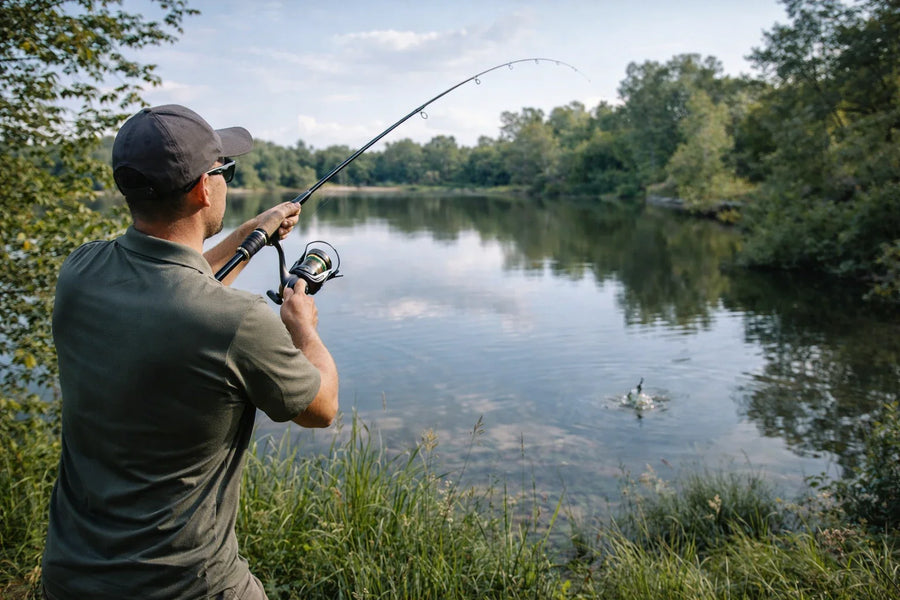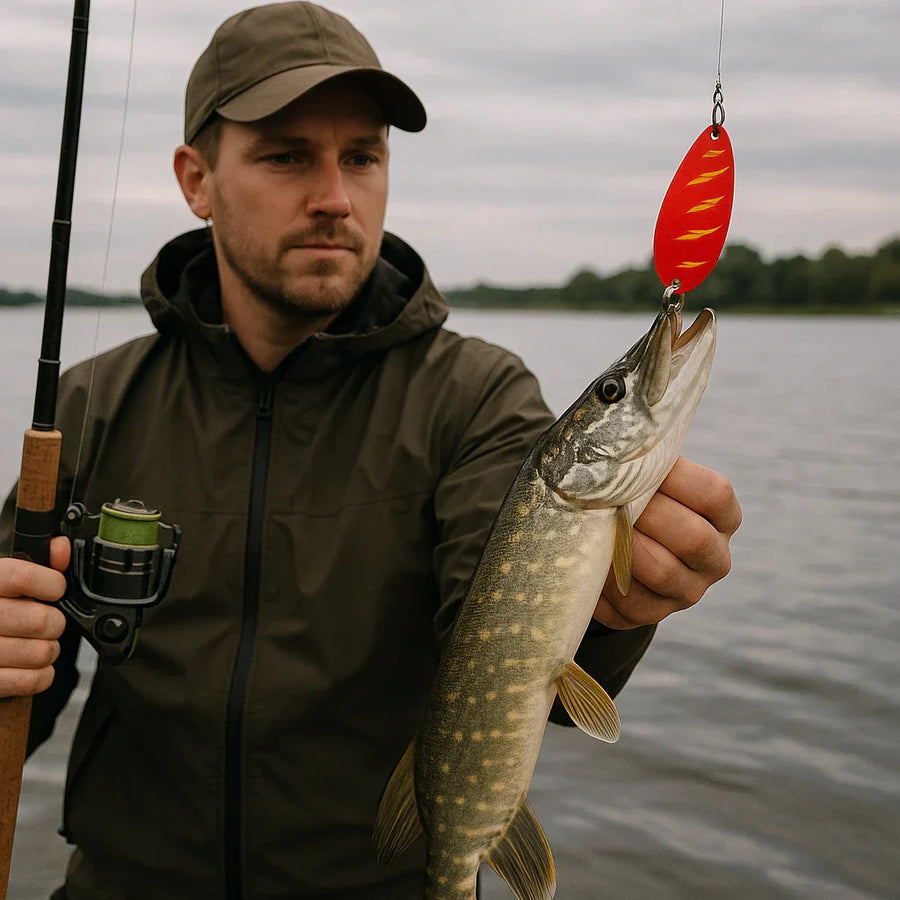
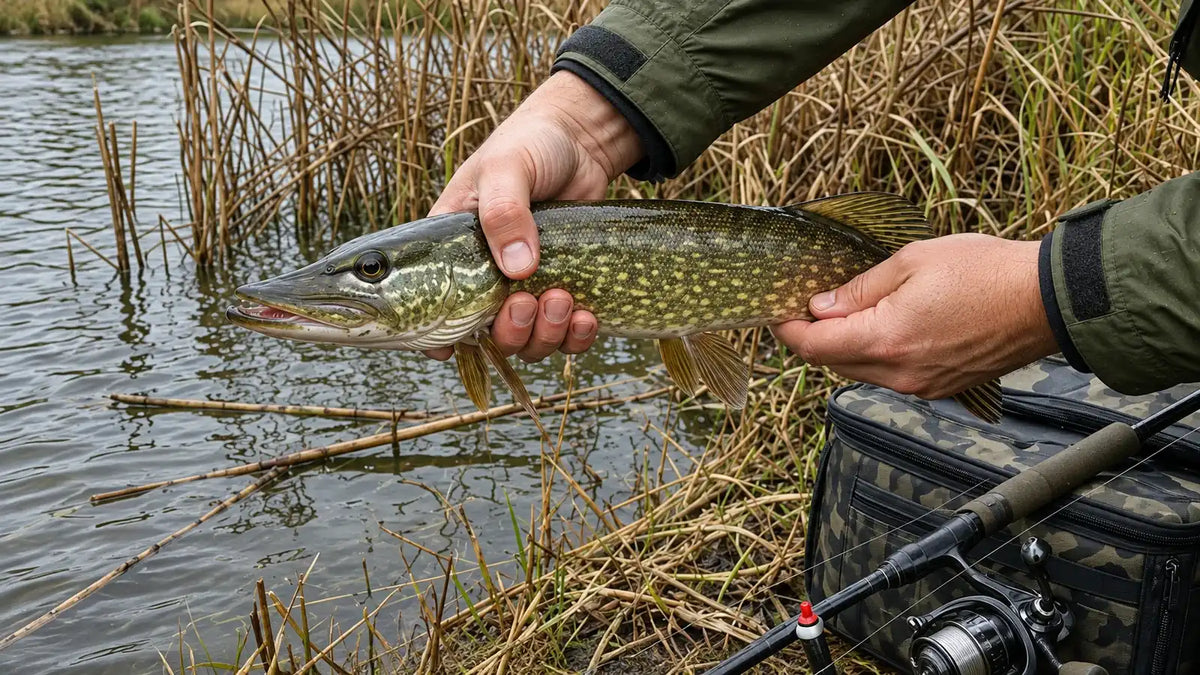
A deadbait that lands neatly on the bottom is only part of a successful pike setup. The tackle also needs to show a pickup quickly, let you make contact with the fish and remain dependable during the fight.
A running pike deadbait rig is a useful starting point on a reasonably clear lakebed or a slow river swim. It separates the weight from the hook trace, so line can travel through the running attachment when a fish moves away. Strong wire, secure bait mounting and correctly adjusted bite indicators make the system work together.
What does a pike deadbait rig need to do?
The hook trace carries the bait, while the lead holds the rig in position. A large-bore run ring allows movement through the weight attachment. A buffer bead protects the lower connection from impact, and a wire uptrace extends protection above the bait trace.
This arrangement suits a bait resting on clean or lightly silty ground. It becomes less effective when the bait disappears into thick weed or the running attachment clogs with debris. Choose a clear patch before adding more components to solve a presentation problem.
Float fishing offers a visible alternative at manageable range, particularly when you can watch the float continuously. A running leger is convenient when depth, distance or surface conditions make a float difficult to read. The following setup uses a running leger with an uptrace.
Tackle for a reliable deadbait setup
A purpose-made pike rod around 12 ft long and roughly 3 lb test curve is a sensible starting point for ordinary bank fishing. Match it to the combined weight of the bait and lead: test curve describes the rod's power and is not a guaranteed casting-weight rating. Use a smooth overhead cast within the manufacturer's guidance.
A fixed-spool reel needs a dependable clutch and enough capacity for your chosen line. For monofilament, start around 18–20 lb breaking strain and increase strength where abrasion or the venue demands it. If choosing braid, use a robust pike setup rather than transferring the fine braid from a perch outfit.
The Pike Anglers' Club (PAC) tackle guidance recommends bait-fishing wire of at least 30 lb and a hook trace at least 18 inches long, approximately 46 cm. Choose a well-made trace that meets both specifications. Heavy fluorocarbon is not a substitute for wire in this setup.
Have these components ready:
- A ready-made wire uptrace about 60 cm long, rated at least 30 lb, with sound swivels and a secure lower connection.
- A large-bore run ring, suitable buffer bead and lead attachment compatible with the uptrace.
- A 1.5–2 oz lead, approximately 43–57 g, as an initial choice for modest range and gentle conditions; use enough weight to hold position.
- A two-treble wire bait trace around 46 cm long, with hook spacing that matches the bait.
- A purpose-made drop-off indicator and an audible alarm arranged to register both a run and movement towards the rod.
Check deadbait rods and leaders and traces by their specifications. A trace sold for general lure fishing may be too short or have the wrong hook arrangement for deadbaiting.
Related tackle for pike deadbait fishing
Choose the rod around the complete bait-and-lead load. Wire material is for anglers equipped to build and test their own traces.
 Fox Predator Warrior Deadbait Rods
Compare the 10ft Boat ’n’ Bank and 12ft Deadbait models for your venue and casting load.
 Westin W2 Multi Purpose ST Deadbait Rod
A dedicated 12ft, 2.75lb option. Check the rod guidance against the total bait and lead weight.
 Fox Predator 49 Strand Coated Steel Wire — 40lb
10m spool with crimps for making traces. The 40lb option exceeds the article’s 30lb minimum; this is not a finished rig.
How to assemble the running rig
Use a ready-made uptrace assembly if you are not equipped to crimp wire correctly. Its upper swivel connects to the mainline; the running weight attachment moves on the wire below it. The bait trace connects at the bottom.
- Prepare the uptrace. Before connecting its lower end, fit the run ring and then the buffer bead. With a finished commercial assembly, use its supplied running attachment and follow its instructions.
- Attach the lead. Connect it to the run ring through a short sacrificial link weaker than the mainline and traces. Use a purpose-made system suitable for the intended casting load; a weak link must not part during the cast.
- Connect the mainline. Tie it to the upper swivel with a knot appropriate to the line material, moisten and tighten carefully, then test the connection.
- Fit the bait trace. Attach its swivel to the uptrace's lower locking link, below the buffer bead. Check that the link is fully closed.
- Test the running path. The ring must move freely, and be able to pass over the upper swivel and line knot if the line breaks above the assembly. Remove anything that traps it.
The order is mainline → upper swivel → wire uptrace carrying the run ring and lead → buffer bead → lower link → wire hook trace → bait. The PAC rig factsheet illustrates this arrangement. Use its layout alongside the stronger wire specification in the club's more recent tackle guidance.
After assembly, pull against each connection with the hooks safely covered. Replace kinked wire, suspect crimps or damaged line before casting. Keep the running attachment free of weed: a ring that slides easily in your hand can still jam when covered in debris.
How to hook deadbait for pike
Start with a bait that fits the trace rather than stretching the hooks across an oversized fish. For a medium bait around 13–17 cm, a size 6 twin-treble trace is a useful reference. Hook patterns and spacing vary; Drennan's bait-trace specifications, for example, pair its size 6 arrangement with that bait-length range.
For a whole deadbait, place one point of the treble nearest the swivel into the firm root of the tail. Lightly nick one point of the other treble into the flank towards the dorsal area, keeping the bait straight and the remaining points exposed. Choose a smaller bait or a different trace if the hooks will not sit neatly.
On semi-barbed trebles, the barbed point holds the bait and the barbless points remain available to hook the fish. Where the fishery requires fully barbless hooks, that rule takes priority. A few turns of bait elastic can support a soft bait, but keep it away from the exposed points.
A mackerel tail section is a practical starting bait because it is relatively firm. Herring or sardine gives you another option, although softer flesh needs more careful mounting and casting. Keep baits chilled and use manageable portions: a large, heavy bait makes a controlled cast harder without guaranteeing a larger pike.
Cast, settle the rig and test bite indication
Begin with a short, smooth cast to a clear area. Slow the line gently just before the rig lands to help the bait trace extend away from the weight. If the bait spins or the rig repeatedly tangles, shorten the cast and check the mounting before fishing farther out.
Once the lead settles, take up loose line without dragging it towards you. Set the drop-off indicator and the reel's line-release arrangement according to the indicator manufacturer's instructions. Open-bail and baitrunner systems need different adjustments; test the complete system you are using.
Pull line away from the rod, then introduce slack as though a fish were swimming towards you. Both movements should produce a clear signal. A front roller alarm alone can miss a drop-back, and with an open bail arm loose line can skip the roller after the rear indicator releases. Keep the rear indicator visible and stay close enough to respond immediately.
On a definite pickup, take the rod, engage the reel, wind down until you feel the fish and set the hooks firmly. Do not wait for a second run or allow a fixed delay for the pike to swallow the bait.

Where to place the bait and what to change
Look for the edge of cover with a clear landing route: a depth change on a lake, the outside of a weedbed, or slack water beside a river's main flow. Casting directly into submerged branches makes both presentation and landing harder. The broader guide to pike fishing in Ireland provides more context for planning a session.
Change one feature of the presentation at a time. If the bait returns covered in weed, move to cleaner ground. If the lead creeps and keeps resetting the indicator, increase its weight within the rod's limits. If the rig is sound but the swim remains quiet, try a different position or bait before rebuilding the entire setup.
Recast after any suspected tangle. Never leave a bait fishing when you cannot trust the indication, and wind the rod in before packing away the landing net or unhooking tools.
Fishing this rig in Ireland
In the Republic of Ireland, live fish cannot be used as bait and an angler may use no more than two rods at once. Coarse deadbaits also have possession restrictions: no more than 12, with qualifying dealer-purchase and receipt requirements when carrying more than four. The exact conditions are set out in Inland Fisheries Ireland's regulations.
Some specified waters require single barbless hooks, so a twin-treble rig is unsuitable there. Establish the rules for the particular water, any permit requirement and permission to access the bank before assembling your tackle. Northern Ireland and Great Britain have separate licensing and fishing rules; the Republic's rules do not apply across those jurisdictions.
Be ready to land and release the fish
Set out a large knotless landing net, wet unhooking mat, long forceps and cutters before the first cast. Arrange your swim so the fish can move from net to mat without being carried over obstacles. If you are new to handling pike, make the first session with an experienced pike angler or guide.
Play the fish firmly on a properly adjusted clutch, support its body during handling and keep time out of water short. Use the cutters when a hook cannot be removed cleanly. Inland Fisheries Ireland's pike-handling advice explains the care needed during unhooking and release. Keep the fish supported in the water until it can swim away strongly.