
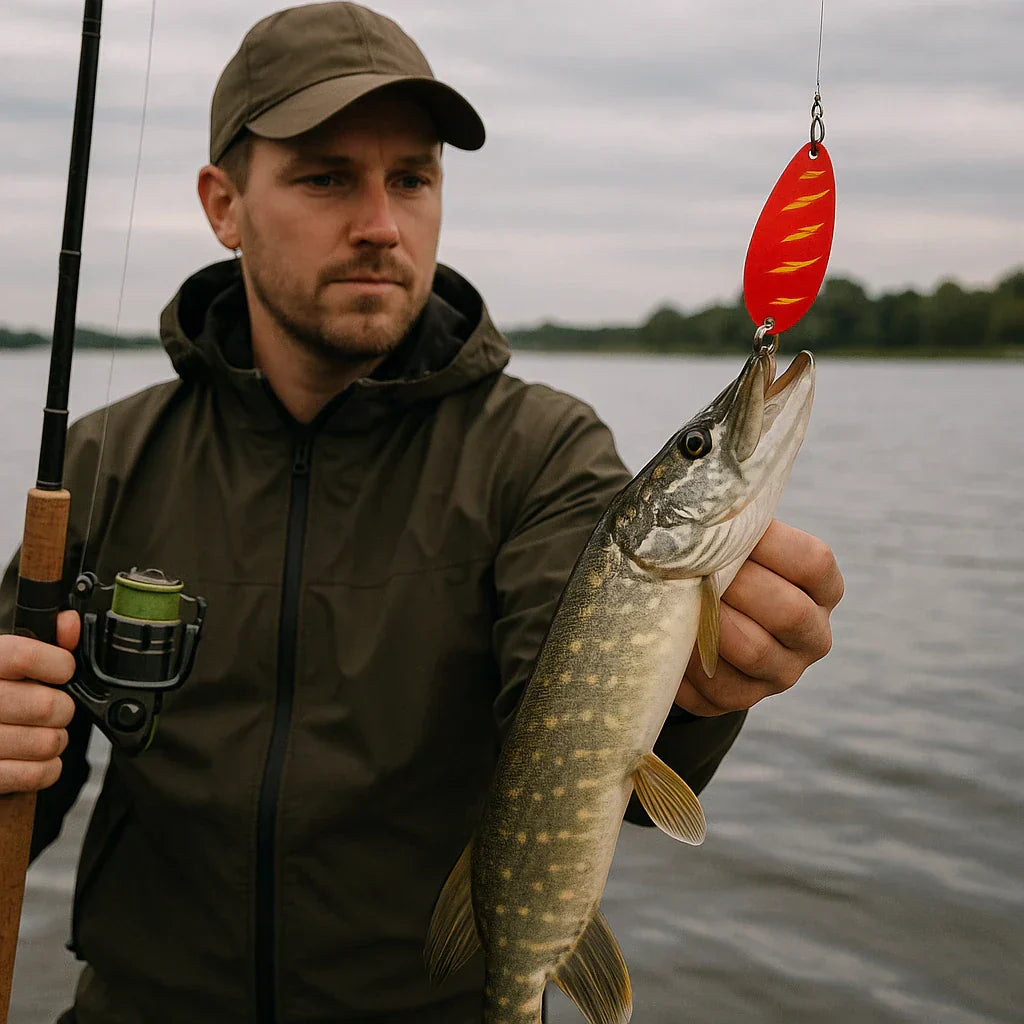
There's a moment I keep coming back to from a session on Lough Ree a few years ago. I'd been working soft plastics for two hours without a touch. The pike were there — I'd seen two follow the lure to the boat and turn away. I switched to a 20g spoon, made three casts along the same weed edge, and had two fish in the next fifteen minutes. Same water, same location, completely different result. The spoon did something the soft plastic didn't.
Metal spoons are one of the oldest lure designs in existence, and they're still producing fish on Irish waters because they do things that no other lure can replicate. This guide covers the techniques that actually work — drawn from decades of experience fishing spoons for pike and perch, including the insights of some of the most respected spoon anglers in the world.
Why Spoons Still Outfish Everything Else in Certain Conditions
Jack Penny, one of North America's most experienced pike anglers with over 60 years of spoon fishing behind him, puts it plainly: "Pike were attracted to spoons for two main reasons — sight and sound/vibration. Various paints and patterns coupled with the metallic backside supply the visual needs, and size, shape, and retrieve speed dictate the audible aspects."
That combination of flash and vibration is what makes spoons uniquely effective in conditions where other lures struggle. In coloured water after rain, when a soft plastic's subtle action is invisible, a 20g spoon's flash and thump carries through the murk. In cold water when pike are lethargic, the flutter of a spoon on the drop — that slow, side-to-side wobble as it sinks — triggers takes from fish that won't chase anything.
Spoons are also the most maintenance-free lure you can carry. No wires to bend, no joints to corrode, no soft bodies to get chewed up. The only maintenance they need is a sharp hook — and that's a five-second job with a hook sharpener.
Choosing the Right Spoon Weight
Weight determines three things: how deep the spoon runs, how far it casts, and how fast it needs to be retrieved to maintain its action. Getting the weight right for the conditions is more important than colour or pattern.
Light Spoons: Up to 5g
Light spoons in the 2–5g range are the perch specialist's tool. They sink slowly, flutter beautifully on the drop, and can be worked at very slow retrieve speeds without losing their action. On clear canals and small rivers where perch are holding in 1–2m of water, a 3g spoon on a slow, steady retrieve just above the bottom is devastatingly effective. The slow sink rate also makes them ideal for fishing over weed — you can count them down to just above the weed tops and keep them there throughout the retrieve.

Berkley Area Game Spoon Roru 3.5g — Fuschia Tip
€5.34
A precision-made 3.5g spoon designed for finesse perch and trout fishing. The compact profile and slow sink rate make it ideal for clear canal and lake fishing where a subtle, fluttering presentation is needed. The fuschia tip adds a trigger point that perch find hard to ignore.
Mid-Weight Spoons: 5–10g
The 5–10g range is the most versatile for Irish perch and light pike fishing. Heavy enough to cast accurately in a moderate wind, light enough to fish slowly in shallow water. These spoons cover the widest range of Irish freshwater situations — canal perch, river perch, small pike on loughs — and should form the core of any spoon box.

Kinetic Pixie Inline 7g — Slimy Green/Silver
€1.99
An exceptional value mid-weight spoon that punches well above its price. The inline design reduces line twist, and the green/silver pattern is a proven perch and pike trigger in Irish conditions. Works brilliantly on a slow, steady retrieve through mid-water.
Heavy Spoons: Over 10g
Heavy spoons in the 15–30g range are the pike angler's workhorse. They cast into a headwind, get down to depth quickly in fast water, and produce the kind of heavy thump and flash that triggers aggressive takes from large pike. On big Irish loughs like Corrib, Mask, and Ree, a 20–25g spoon worked along a weed edge or over a drop-off is one of the most reliable pike presentations there is.

Abu Garcia Atom Spoon 20g — Redhead
€5.45
A classic pike spoon in the ideal 20g weight for most Irish lough and river conditions. The redhead pattern is one of the most proven pike colours across all seasons. Casts accurately, sinks quickly, and produces a strong wobbling action that pike find irresistible.

Abu Garcia Classic 3 Pack Atom Spoons
€12.60
Three proven Atom spoons in a single pack — excellent value for building a spoon box. The classic Abu Garcia Atom has been catching Irish pike for decades and remains one of the most reliable heavy spoons available.
The Three Retrieves That Catch Fish
1. The Steady Retrieve
The most basic spoon retrieve — and often the most effective. Cast, let the spoon sink to the desired depth, then wind steadily at a speed that keeps the spoon wobbling without turning over. If the spoon turns over, you're going too fast. This is the rule that Jack Penny has applied for 60 years, and it's the most common mistake beginners make with spoons. A spoon that's spinning rather than wobbling has lost its action and its appeal.
The right speed varies with every spoon. Before you start fishing a new spoon, hold it next to the boat or bank in clear water and watch it. Find the slowest speed at which it wobbles cleanly — that's your baseline retrieve speed. In cold water, fish it slightly slower. In warm water with active fish, you can speed up.
2. The Drop-Back — The Most Underused Technique in Spoon Fishing
Spence Petros, one of the most respected pike and muskie anglers in North America, discovered this technique by accident — watching a 13-year-old boy consistently outfish two experienced adults on the same spoons. The boy kept stopping his retrieve to eat, drink, or look at something, and every time he stopped, a pike hit.
The drop-back works because pike often follow a spoon without committing. They track it, get interested, but won't attack a lure moving steadily away from them. When the retrieve stops and the rod tip drops back toward the lure, the spoon flutters backwards — directly into the face of the following fish. That sudden reversal, combined with the flutter action of the sinking spoon, triggers an instinctive strike.
To execute it: cast, retrieve for a few turns, then stop completely and drop the rod tip back toward the lure. Let the spoon flutter for 2–3 seconds, then resume the retrieve. Repeat every 5–10 turns. Most takes happen in the first second after the retrieve stops. This technique is particularly effective in autumn on Irish loughs when pike are following but not committing to a steady retrieve.
3. The Flutter Sink — For Difficult, Pressured Fish
When pike are inactive — after a cold front, in very clear water, or on heavily fished venues — a slow, fluttering sink is often the only presentation that gets a response. Cast the spoon out, let it sink on a semi-slack line, and watch the line for any movement that indicates a take on the drop. Every few seconds, lift the rod tip to make the spoon rise, then let it flutter back down. The side-to-side wobble of a spoon sinking through the water column is one of the most natural-looking movements in fishing — it perfectly imitates a dying or stunned baitfish.
This technique works best with lighter spoons (5–10g) that have a slow, wide flutter on the sink. Heavier spoons sink too fast and don't produce the same action. On clear Irish canals in winter, this is often the only method that produces perch when everything else has failed.
Colour: The Rules That Actually Hold
Colour selection for spoons is simpler than most anglers make it. The key variables are water clarity and light conditions:
- Clear water, bright sun: Silver, natural baitfish patterns, subtle metallics. The fish can see clearly — a garish lure looks unnatural.
- Stained or coloured water: Gold, copper, red and white, fire tiger. The metallic finish carries through colour that would absorb other patterns.
- Very murky water: Fluorescent chartreuse, orange, or yellow. Pike use vibration as much as sight in these conditions, but a bright colour helps them locate the lure.
- Low light (dawn, dusk, overcast): Gold or copper backs outperform silver. The warmer metallic tones reflect low-angle light more effectively.
Tackle: What You Actually Need
For spoon fishing, a spinning rod in the 7–9ft range rated for the weight of spoons you're using is the standard setup. A rod rated 5–25g covers light to mid-weight spoons for perch; a rod rated 15–40g handles the heavier pike spoons. The rod needs enough backbone to set the hook on a hard take — pike hits on spoons can be explosive — but enough tip sensitivity to feel the spoon working.

Abu Garcia Cardinal X Spinning Reel
€28.00
A reliable, smooth-running spinning reel that pairs perfectly with a spoon fishing setup. The consistent drag handles the sudden, hard takes that spoon fishing produces, and the smooth retrieve makes it easy to maintain the steady speed that spoons need to work correctly.
For line, braided line in the 10–20lb range is the best choice for spoon fishing. The lack of stretch means you feel the spoon's action throughout the retrieve and detect takes instantly. A short fluorocarbon leader of 20–30lb is essential for pike — their teeth will cut through braid in seconds. Use a quality snap swivel to connect the leader to the spoon, which allows quick lure changes and prevents line twist.

Berkley x9 Braid Line 150m
€24.95
A high-quality 9-strand braid with excellent sensitivity and a smooth, thin profile that cuts through wind and water. Ideal for spoon fishing where feeling the lure's action and detecting takes instantly makes the difference between a good session and a blank.
One Modification That Makes Any Spoon Better
Jack Penny's most valuable piece of advice for spoon fishing: replace the treble hook with a quality single hook. A single hook penetrates more easily than a treble, fish dislodge it less often during the fight, and it makes unhooking and releasing fish significantly quicker and safer. The rocking action of the spoon combined with a single hook pointing to the inside (concave side) also makes it more weedless — when the spoon picks up weed, a few sharp jerks of the rod clear it cleanly.
Use a single hook sized so the edges of the hook are close to the edges of the spoon without extending beyond them. Too large a hook grabs weeds; too small a hook misses fish. The Kinetic Inline Single Hook Kit covers the range of sizes you'll need for most spoon fishing situations.

Kinetic Inline Single Hook Kit
€4.99
A selection of inline single hooks in multiple sizes — ideal for replacing trebles on spoons. Inline single hooks improve hook penetration, make unhooking faster and safer, and reduce weed pick-up. One of the best value modifications you can make to your spoon fishing setup.
Browse our full range of light spoons, mid-weight spoons, heavy spoons, spinners, and all the terminal tackle you need for spoon fishing at Emerald Ripple.