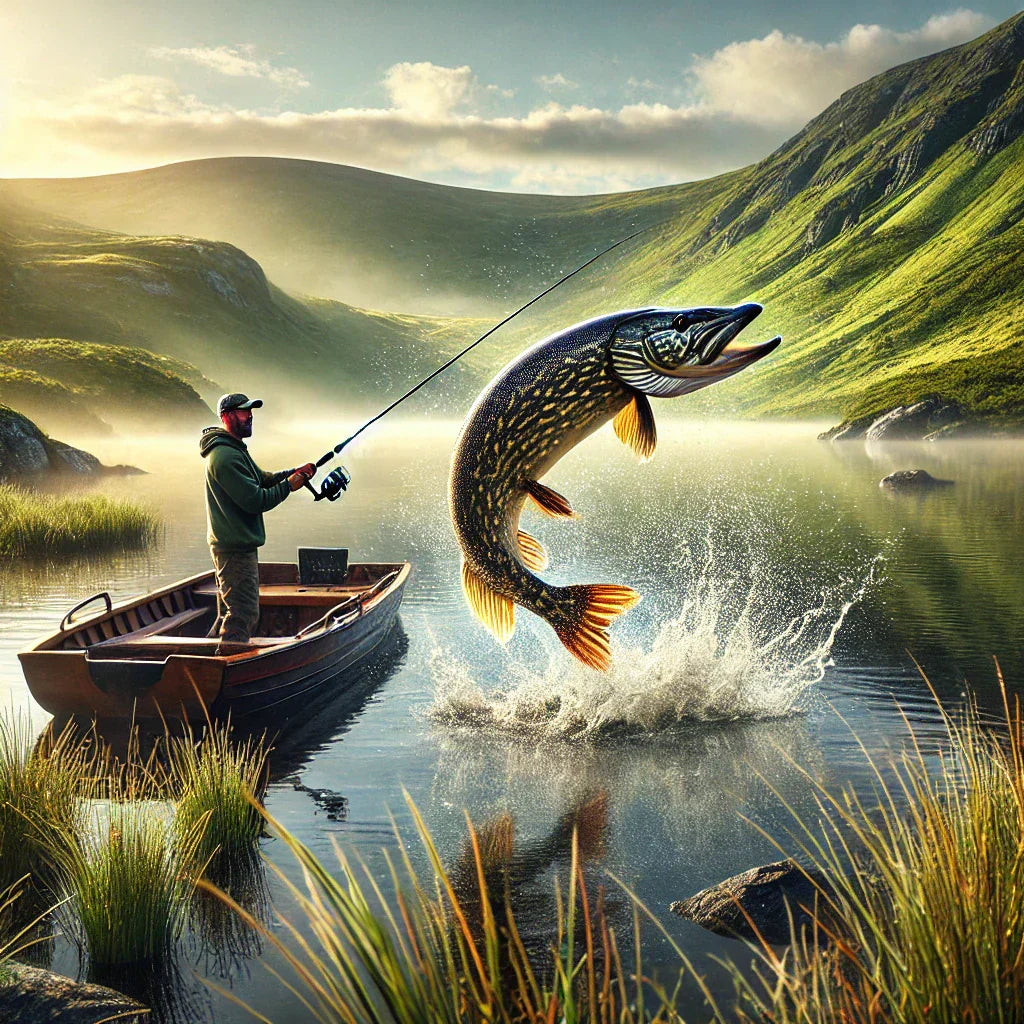
There's a particular kind of silence that settles over a big Irish lough just before a pike takes. The water is flat, your lure is working through a weed edge, and then — nothing gradual about it — the rod bends hard and something heavy and angry is pulling line off the reel. Pike fishing does that to you. It doesn't ease you in. It grabs you.
Ireland has become one of Europe's premier destinations for pike angling, and if you haven't fished here for them yet, this guide will tell you everything you need to know — from the history of how they got here, to where to find them, how to target them, and what gear actually works.
How Pike Came to Ireland
This is the part that surprises most people. Pike are not native to Ireland. Archaeological evidence shows no trace of the species in Irish waters before the Middle Ages — no bones, no records, nothing. The rivers and lakes that now hold some of the biggest pike in Europe were, for most of history, entirely without them.
Their introduction was deliberate. During the 18th and 19th centuries, pike were brought over from mainland Europe — most likely from Britain and the continent — as part of efforts to develop local fisheries and improve angling. It was a calculated decision, made by landowners and estate managers who wanted to offer better sport fishing on their waters. What they created, perhaps without fully understanding it, was an ecological transformation that is still playing out today.
Pike thrived in Ireland's rich, relatively undisturbed freshwater systems. With abundant prey, clean water, and little competition at the top of the food chain, they grew large and spread widely. Within a few generations they had colonised rivers, lakes, and canals across the country. The species that wasn't here at all a few centuries ago is now as associated with Irish fishing as brown trout or salmon.
The Pike as a Predator: Understanding What You're Fishing For
To catch pike consistently, you need to understand how they think — or rather, how they hunt. Pike are ambush predators. They don't chase prey across open water the way a perch or a bass might. They find a position — a weed edge, a sunken tree, a drop-off where shallow water meets depth — and they wait. When something comes within range, they accelerate explosively and strike. The whole attack can be over in a fraction of a second.
This ambush strategy shapes everything about how you fish for them. It means location matters enormously. A pike sitting in open water in the middle of a lake is a pike that isn't feeding. A pike tucked into the shadow of a reed bed with a clear view of a patrol route is a pike that will eat your lure if you put it in the right place at the right speed.
Adult pike sit at the top of the food chain in every water they inhabit. They eat roach, bream, perch, and smaller pike without hesitation. They'll take frogs, waterfowl, and small mammals if the opportunity arises. There are well-documented accounts of pike attacking ducklings on Irish loughs, and the stomach contents of large fish have included everything from eels to rats. This isn't exaggeration — it's just what apex predators do.
The ecological debate around pike in Ireland is real and ongoing. Pike exert significant pressure on wild brown trout and salmon parr, which is why some fishery managers on salmonid rivers actively control pike numbers. On coarse fisheries and large loughs, the relationship is more balanced, and pike are generally left to manage themselves. As an angler, it's worth being aware of the local rules around catch-and-release versus removal — they vary significantly between waters.
Where to Fish: Ireland's Best Pike Waters
Ireland's geography is almost perfectly designed for pike. The midlands are scattered with large, shallow loughs full of roach and bream — exactly the kind of prey-rich environment that produces big fish. The Shannon system alone — connecting Lough Allen, Lough Ree, and Lough Derg — offers hundreds of kilometres of pike water, from narrow reed-lined channels to vast open loughs where fish of 20lb and above are caught every season.
Lough Corrib in County Galway is one of the most famous pike fisheries in Europe. It's a huge, complex water with enormous variety — shallow bays, deep channels, rocky points, and vast weed beds — and it holds a population of genuinely large fish. Visiting anglers regularly report fish in the high teens and low twenties of pounds, and the lough record stands well above that.
Lough Derg, the largest lake on the Shannon, is another destination that draws pike anglers from across Europe. The combination of size, depth variation, and a huge roach population makes it ideal for big fish. Trolling is popular here, particularly in the colder months when fish are deeper and less willing to chase a cast lure.
Lough Ree sits in the middle of the Shannon system and hosts the famous Lough Ree Predator Challenge — one of Ireland's most prestigious pike competitions. The event draws serious anglers and has produced some remarkable fish over the years. The King of the Lake competition, held on various Irish loughs, has similarly helped establish pike as a flagship species for Irish sport fishing tourism.
Beyond the headline venues, Ireland has hundreds of smaller loughs and river systems that hold pike and see far less pressure. Some of the most enjoyable sessions I've had were on small midland lakes where you could walk the bank, spot fish cruising the margins, and sight-cast to them — a style of fishing that feels more like stalking than anything else.
Methods: How to Target Pike Effectively
Lure fishing is the most active and, for many anglers, the most satisfying way to fish for pike. You're covering water, reading the environment, and making decisions on every cast. Jerkbaits are particularly effective for big fish — the erratic, wounded action triggers aggressive strikes from pike that might ignore a more predictable lure. Work them with sharp downward rod pulls and irregular pauses, keeping the retrieve unpredictable.
Minnows and crankbaits are excellent all-round pike lures, especially in the 10–18cm range. A slow-sinking or suspending crankbait worked along a weed edge at dawn is one of the most reliable pike presentations I know. Tail spinners and vibe lures come into their own in colder water when you need to get deep quickly and keep the lure in the zone longer. Swimbaits have grown in popularity for targeting very large fish — a big, realistic swimbait worked slowly through a known holding area is hard for a double-figure pike to ignore.
Soft lures rigged on heavy jig heads are versatile and effective, particularly for fishing drop-offs and deeper water. The natural action on the fall often triggers takes from fish that have followed without committing.
Deadbait fishing is the traditional method and still produces the biggest fish, particularly in winter. A static or slowly drifted deadbait — roach, smelt, mackerel, or lamprey — presented on a pike float over a known holding area is a proven approach for targeting specimen fish. The key is patience and positioning: get the bait into the right spot and leave it there long enough for a pike to find it.
Trolling is widely used on the larger Irish loughs, particularly Derg and Corrib, where covering water efficiently matters. Running lures behind a slow-moving boat through known pike corridors — channel edges, weed lines, depth transitions — allows you to search large areas systematically and is particularly productive in autumn and early winter.
Tackle: What You Actually Need
Pike are powerful fish and they live in snaggy, weedy environments. Your tackle needs to be up to the job.
For lure fishing, a baitcasting rod in the 7–8ft range paired with a multiplier reel gives you the control and power for working larger lures accurately. For lighter presentations and spinning, a spinning rod rated MH or H with a quality spinning reel works well. Baitrunner reels are the standard choice for deadbait fishing — the free-spool function lets a pike run with the bait before you strike.
Line choice matters. Braided line in the 30–50lb range is the standard for lure fishing — it has no stretch, which means direct contact with the lure and instant strike transmission. For deadbaiting, monofilament in the 15–20lb range is widely used for its stretch and forgiveness during the fight.
A wire or heavy fluorocarbon leader is non-negotiable. Pike teeth will cut through braid and mono instantly. Use a purpose-made pike leader or trace of at least 30cm — longer if you're fishing with large lures or in snaggy conditions.
For hooks, treble hooks are standard on most pike lures and deadbait rigs. Make sure they're sharp and replace them at the first sign of rust or blunting. A pair of long-nosed forceps and pliers are essential for unhooking safely — pike have serious teeth and a mouth full of them. Never put your fingers near the gills or attempt to unhook a pike without the right tools.
A large landing net and an unhooking mat are standard kit for responsible pike fishing. These are big fish that deserve to be handled carefully, especially if you're returning them.
Seasons and Timing
Pike can be caught year-round in Ireland, but the fishing changes significantly with the seasons.
Autumn (September–November) is widely considered the prime time. Water temperatures are dropping, pike are feeding hard to build condition ahead of winter, and fish that have been inactive through the warmest months start moving and hunting aggressively. Lure fishing is at its best in autumn — fish are willing to chase and cover water.
Winter (December–February) produces the biggest fish. Cold water slows pike's metabolism, but it also concentrates them in predictable areas — deep holes, channel bends, the mouths of inflowing streams. Deadbait fishing comes into its own in winter. The fish aren't moving much, but a well-placed bait in the right spot will get eaten.
Spring (March–May) brings the pre-spawn and spawn period. Large females move into shallow, weedy bays to spawn, and this is when the biggest fish of the year are often encountered. Many anglers choose not to target pike during the actual spawn out of respect for the fish, but the weeks immediately before and after can be exceptional.
Summer pike fishing is the most challenging. Warm water pushes fish deep and makes them lethargic. Early mornings and late evenings are the most productive windows, targeting shaded areas and deep weed edges where the water stays cooler.
Explore Our Pike Fishing Range
Everything you need for pike fishing in Ireland is available at Emerald Ripple. Browse our full selection of lures — including jerkbaits, minnows and crankbaits, swimbaits, soft lures, and tail spinners — alongside rods, reels, lines, pike floats, leaders and traces, treble hooks, forceps, landing nets, and unhooking mats.
Whether you're planning your first pike session or chasing a personal best on Corrib, we've got the gear to make it happen.